
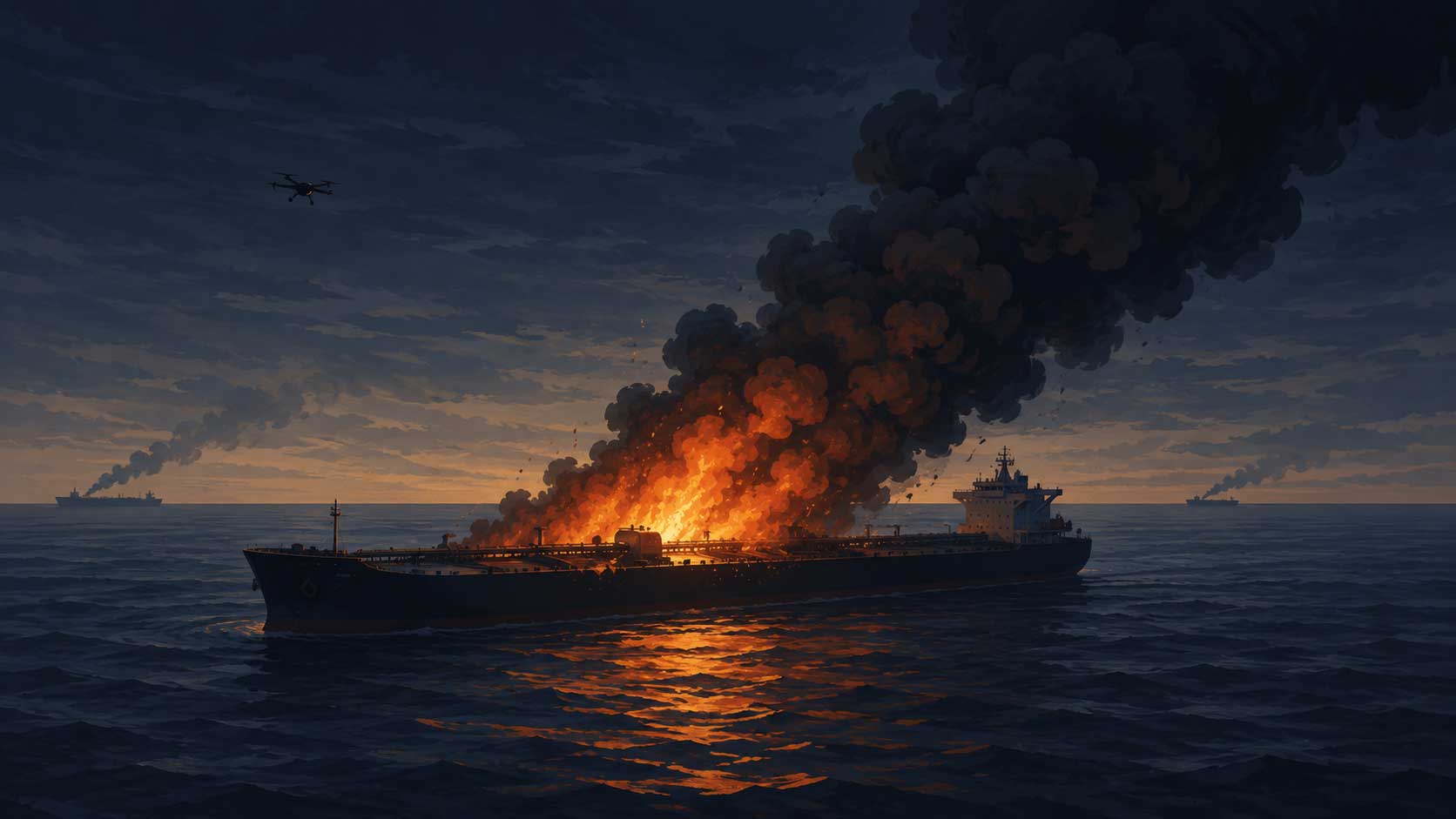
UPDATE 9 July 2026: Ukraine’s Unmanned Systems Forces struck 14 more vessels in the Sea of Azov overnight 8-9 July, bringing the campaign total to 35 vessels across four nights. Five vessels appear on the strike record twice as repeat hits. FleetLeaks has published a separate piece covering the extended campaign and the four-night manifest.
Between the nights of 5 July and 8 July 2026, Ukraine’s Unmanned Systems Forces struck 21 vessels in the Sea of Azov. The tally, per Ukraine’s SBS commander, is 19 fuel tankers, one dry cargo ship, and one ferry, all moving through the Azov-Crimea corridor that supplies fuel and cargo to the Russian occupation of the peninsula. It is the fullest 72-hour period of shadow-fleet losses since Russia’s full-scale invasion of Ukraine began in 2022.
FleetLeaks tracks the shadow fleet because those vessels are the operational infrastructure of Russia’s oil revenues and its military resupply of occupied territory. What Ukraine hit between 5 and 8 July is not an incidental target set. It is the specific fleet that keeps occupied Crimea fuelled. This piece documents the vessels involved, their operators, and the wider Ukrainian campaign that these strikes form the naval phase of.
Method and data sources
Primary reporting on the strike claims comes from Ukraine’s Unmanned Systems Forces via SBS commander Robert “Madyar” Brovdi, cited by the Kyiv Independent, Kyiv Post, Ukrainska Pravda, Ukrinform, Reuters, and Euromaidan Press. Vessel identification against IMO numbers was published by The Insider for the 5-6 July pair (using video-frame identification from strike footage) and by maritime intelligence firm Ambrey via Equasis alignment for the 6-7 July eight, as reported by Seatrade Maritime.
FleetLeaks vessel data comes from the sanctions pipeline (US OFAC, EU, UK OFSI, Canada SEMA, Australia DFAT, New Zealand, Switzerland SECO, aggregated via OpenSanctions cross-check) and from FleetLeaks change-history records derived from Equasis and third-party registries. Denominators (total sanctioned tankers, Russian-flagged sanctioned tankers, Russian-flagged product tankers) are drawn from FleetLeaks vessel records as of 8 July 2026. Kremenchug Institute of the Economy (KSE) shadow-fleet monitoring reports are cited for the operator-cluster analysis.
The Kyiv Independent has flagged that Ukraine’s damage claims are not independently verified. FleetLeaks holds the same caveat on the vessel-strike count. Vessel identities and sanction status are drawn from public registries and are independently verifiable.
The 72-hour naval campaign
The Azov Sea strikes unfolded across three consecutive nights. All targets were vessels transiting the Rostov-on-Don, Taganrog, and Yeysk to Kerch fuel corridor. Strike execution came primarily from the Kairos battalion of the 414th Separate Brigade of the SBS, joined on the third night by the 413th Regiment “Raid” and the 1st SBS Center.
| Night | Vessels struck | Named | Notes |
|---|---|---|---|
| 5-6 July | 2 tankers | Kapitan Barmin, Sanar-4 | Both Project 15781 class, Taganrog to Crimea, ~7,000 tons gasoline each. Identified by The Insider from strike video footage. |
| 6-7 July | 8 tankers, 1 cargo ship, 1 ferry | Venus III, Sanar-1, Sanar-17, Teti, Aleksey Savrasov, Penelope, Climene, Ivan Cheremisinov | Cargo ship and ferry unnamed as of publication. |
| 7-8 July | 9 tankers | None named as of publication | Identification pending from maritime intelligence firms. |
| Total | 21 vessels (19 tankers + 1 cargo + 1 ferry) | 10 identified | – |
Rostov Oblast Governor Yuri Slyusar (Russian side) confirmed damage to two tankers in Taganrog Bay on the third night, said one crew was evacuated, and stated the tankers were empty. He reported no oil spill and two injuries requiring medical assessment. Russian confirmations for the earlier nights have not been issued at the vessel level. Ukraine’s General Staff report, echoed by Kyiv Post, describes the eight tankers hit on 6-7 July as “destroyed.” That language reflects a Ukrainian military assessment and cannot be independently verified from open sources at present. Actual damage state per vessel will become clearer as AIS records show which vessels return to service.
Ambrey has separately assessed that the wave of attacks represents a significant escalation in the Ukraine maritime-security threat picture and a genuine shift in how the war is being fought at sea, warning of a realistic possibility of reciprocal Russian action against Ukraine-linked shipping within a 2-5 day window (Seatrade Maritime coverage of the Ambrey assessment).
The Crimea blockade: the wider campaign these strikes complete
The naval strikes do not stand alone. They are the culminating chapter of a multi-month, publicly articulated Ukrainian strategy to isolate occupied Crimea by cutting every logistical artery that supplies it. Ukraine’s Defense Minister Mykhailo Fedorov described the operation on 17 June: “Hell is beginning. Logistics are being cut off. Crimea is being isolated.” President Zelenskyy’s own framing for the parallel refinery campaign is “long-range sanctions.”
Four campaign components have been running simultaneously:
- Air campaign against Russian refineries. Ukrainian long-range drones have struck Russian oil refineries at least 194 times in the first half of 2026, per Financial Times reporting on data from Rochan Consulting. Ukraine’s Ministry of Defence reports 11 refineries struck in June alone, with a total processing capacity above 12 million tons per year affected. Key hits in the campaign window: Slavyansk-na-Kubani (28 June, key Crimea fuel supplier), Yaroslavl (28 June), the Kapotnya refinery in Moscow (12 and 18 June), Ufa (early July), Saratov and a Tatarstan petrochemical plant (overnight 8 July) (Ukraine MoD June summary, United24 FT data).
- Strikes on Crimean energy infrastructure. The Sevastopol main power substation was struck seven times in a single overnight window in late June. Saki thermal power plant, Simferopol Power Station, and Kerch oil terminal were all hit through June. Russian-installed authorities declared a state of emergency across Crimea and Sevastopol on 26 June and suspended civilian fuel sales on 21 June, reserving supplies for government agencies (Moscow Times, Kyiv Independent).
- Land logistics. Ukraine has systematically targeted the R-280 “Novorossiya” highway (the main Russia-to-Crimea land route through occupied Ukraine) since April 2026. A railway bridge over the North Crimean Canal near Rozdolne was destroyed on 23 June. Another railway bridge near Ichky was hit in late June. Kerch Bridge traffic has been repeatedly disrupted.
- Naval logistics. The 5-8 July Azov strikes documented in this piece. Ukraine’s Ministry of Defence, in its June summary, singled out oil depots in Feodosia and Kerch (~300-350 km from the Ukrainian border) as systematic naval-supply targets.
The 21-vessel Azov total is what a four-component blockade looks like when its naval phase reaches peak intensity. Kremlin-installed Crimea head Sergei Aksyonov has stated the peninsula requires 70,000 tons of fuel per month. Nineteen tankers of approximately 7,000 tons capacity, if all lost, would represent roughly 133,000 tons of fuel-delivery capacity removed from the corridor in a single 72-hour window. Ambrey and other maritime security analysts have not yet published a final damage assessment.
The ten identified vessels: a mixed sanctions picture
Of the 21 vessels reported struck, ten have been publicly identified against IMO numbers as of 8 July 2026. All ten are Russian-flagged. The nine tankers hit on 7-8 July have not been publicly identified.
| Vessel | IMO | Built | DWT | Type | Sanctions status |
|---|---|---|---|---|---|
| Venus III (Venera-3) | 9599353 | 2011 | 7,102 | Product tanker | UK, EU, CA, AU, NZ, CH |
| Sanar-1 | 9332389 | 2004 | 5,420 | Product tanker | Not designated |
| Sanar-4 | 9476771 | 2010 | ~7,000 | Product tanker (Project 15781) | Not designated |
| Sanar-17 | 9640554 | 2012 | 7,036 | Product tanker | Not designated |
| Teti | 9540352 | 2010 | 7,509 | Chemical/oil products tanker | Not designated |
| Aleksey Savrasov | 9645061 | 2013 | 7,013 | Chemical/oil products tanker | EU, CA, CH |
| Penelope | 9540364 | 2010 | 7,476 | Chemical/oil products tanker | Ukraine GUR portal listed; no Western designation |
| Climene | 9376593 | 2006 | 5,600 | Product tanker | Not designated |
| Kapitan Barmin | 9269350 | 2003 | ~7,000 | Product tanker (Project 15781) | Not designated |
| Ivan Cheremisinov | 9246657 | 2002 | 1,635 | Hopper dredger | Not designated; owned by Rosmorport (Russian state) |
One observation matters for FleetLeaks’s core reporting mission: only two of the ten identified vessels are on Western sanctions lists. One additional vessel (Penelope) appears on Ukraine’s War and Sanctions portal maintained by GUR, the Ukrainian military intelligence agency, but has no Western designation. Seven remaining vessels have no formal designation from any jurisdiction whose sanctions FleetLeaks tracks. Ivan Cheremisinov’s registered owner, Rosmorport, is a Russian state entity subject to secondary sanctions in multiple jurisdictions, but the vessel herself is not directly listed.
Ambrey’s independent assessment reaches the same observation. Their analyst statement notes that “many of the identified vessels are subject to international sanctions from jurisdictions including Ukraine, EU and the US, or operating for companies subject to similar sanctions, predominantly for the transport of Russian oil,” but adds that “sanctions status alone was likely not the determining factor in target selection; the vessels’ role in sustaining fuel deliveries to Crimea was likely the primary consideration.”
The interpretation of that pattern matters. The Azov-Crimea fuel corridor operates predominantly with Russian-flagged tanker tonnage whose operators run the run domestically, from Russian yards through Russian ports to Russian-occupied Crimea. These vessels do not need the reflagging, dark-fleet aliases, and shell-owner laundering that Western sanctions were designed to detect. They stay under Russian flag, register with Russian companies, and never call at Western ports. Western sanctions, built around foreign-flag deceptive shipping practices, have left this specific operational profile largely uncovered. Ukraine’s drone force is filling that coverage gap operationally, at approximately 7,000 tons of tanker capacity per strike.
How the 21 vessels compare to the global sanctioned tanker fleet
Because most of the ten identified vessels are not in the Western sanctions databases, direct benchmarking against “sanctioned tanker” totals understates what a 72-hour, 19-tanker loss represents for the specific fleet that runs the Azov-Crimea corridor. FleetLeaks tracked the following totals as of 8 July 2026:
| FleetLeaks-tracked pool | Count | 19 tankers as share |
|---|---|---|
| All sanctioned vessels tracked | 917 | 2.1% |
| Sanctioned tankers (all types) | 676 | 2.8% |
| Russian-flagged sanctioned tankers | 237 | 8.0% |
| Russian-flagged sanctioned product/chemical tankers | 111 | 17% |
The tightest benchmark is the Russian-flagged, sanctioned product and chemical tanker pool. Nineteen tankers over 72 hours represents 17 percent of that pool. In practice, the operational pool running the Azov-Crimea corridor is smaller still. That corridor uses vessels of approximately 7,000 tons deadweight and around 140 meters length, sized for the Volga-Don Canal and the Kerch Strait approach. That is a specific class, not a general one. If the 19 tankers hit are drawn from a corridor-active pool of 50-80 vessels, the loss rate is materially higher than 17 percent.
KSE Institute reporting from September 2025 identified 26 tankers involved in transporting Russian crude, plus 28 tankers transporting Russian petroleum products, that met shadow-fleet criteria without any Western sanctions designation. Six of the ten named 5-7 July vessels fall into precisely that unsanctioned-shadow-fleet-operator category KSE has been documenting for years.
Two vessels FleetLeaks has full records on
Two of the ten identified vessels, Venus III and Aleksey Savrasov, are already part of FleetLeaks’s tracked vessel database because they carry Western sanctions designations. For both, FleetLeaks holds full identity-change history, sanctions timelines, and vessel photographs. The other eight named vessels are not yet in the FleetLeaks database, because they carry no Western designation that would have triggered ingestion.
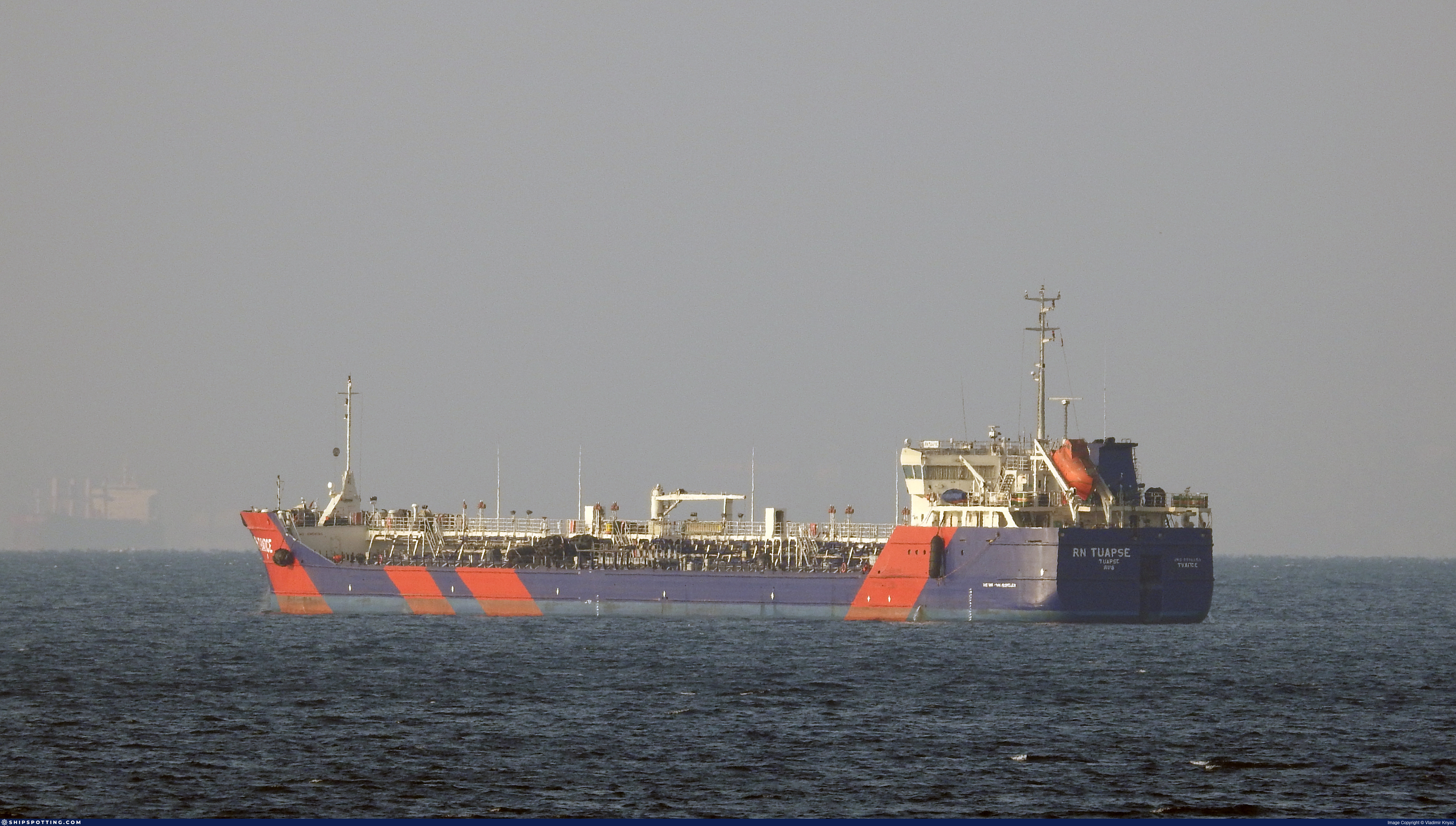
Venus III (Venera-3), IMO 9599353
Built in 2011, Russian flag, 7,102 DWT product tanker. Sanctioned by UK (May 2025), Canada (June 2025), EU and Switzerland (April 2026 in the 20th sanctions package), Australia and New Zealand (February 2026).
Venus III’s identity history in FleetLeaks records: originally Svl Glory under Russian flag, then reflagged to Malta in April 2014, renamed RN Tuapse in October 2014, reflagged to Palau and renamed Venus I in February 2023, then reflagged back to Russia and renamed Venus III in January 2025. Registered ownership passed through SVL MARITIME B LTD to AQUASYNC TECHNOLOGIES FZE (March 2024) to RUI LIN SHIPPING LTD (October 2024). Twelve years of successive reflaggings, renames, and shell-owner transitions, ending with the vessel back under Russian flag and under multiple Western designations. On 15 April 2026, Venus III conducted a ship-to-ship transfer at the Port Said outer anchorage with the sanctioned tanker KAMELOT, an event FleetLeaks documented in April. Nine days later she was re-listed in the EU’s 20th sanctions package. Ten weeks after that, she was hit by Ukrainian drones in the Sea of Azov.
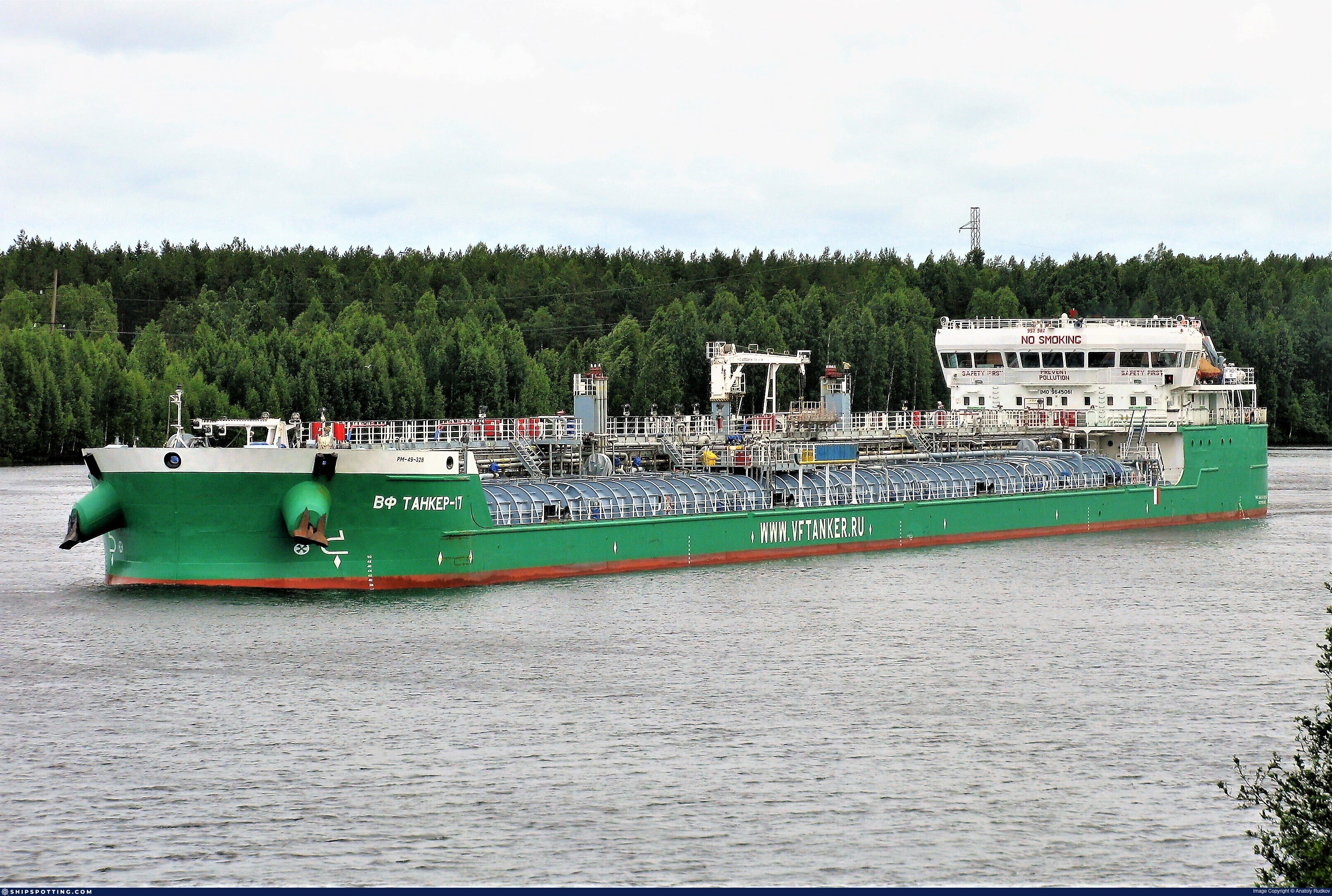
Aleksey Savrasov, IMO 9645061
Built in 2013, Russian flag, 7,013 DWT chemical and oil products tanker. Sanctioned by the EU and Switzerland in October 2025 (as part of the 19th sanctions package) and by Canada in March 2026.
Aleksey Savrasov was originally named Vf Tanker-17 and owned by Volga Shipping. In August 2023 she was renamed to Aleksey Savrasov (after the 19th-century Russian painter) and ownership was transferred to Ilya Muromets JSC. That renaming batch produced her name in the same series that produced Ivan Aivazovsky, Mikhail Ulyanov, and Mikhail Lazarev. These vessels of the state-linked Russian tanker fleet renamed in 2023 as part of a rebranding away from generic VF-Tanker identifiers. Aleksey Savrasov’s operational history since designation shows continued activity on the Azov-Rostov-Crimea corridor. She was struck on 6-7 July 2026, approximately 20 months after her EU designation.
The eight remaining named vessels (Sanar-1, Sanar-4, Sanar-17, Teti, Penelope, Climene, Kapitan Barmin, and Ivan Cheremisinov) carry no Western sanctions designation and are therefore not currently in FleetLeaks’s ingested vessel database. These vessels are not currently in the FleetLeaks database because the ingestion pipeline is built around Western sanctions lists, and no such designation applies to them at present.
The corridor and its economics
Every named vessel struck between 5 and 8 July was operating on the same commercial route: Russian mainland ports on the northern Sea of Azov (Rostov-on-Don, Taganrog, Yeysk) to occupied Crimean ports (Kerch, Port Krym, Kavkaz, and previously Kamysh-Burun and Yeysk-Feodosia terminals). Cargo on those routes, per Ukrainian military statements and Rostov Oblast official confirmations, is gasoline, diesel, and jet fuel destined for the Russian military presence on the peninsula and, until 21 June, for the Crimean civilian population.
The corridor economics shape the class of vessel involved. The Volga-Don Canal and the Kerch Strait approach constrain tonnage to vessels below approximately 140 meters length and 7,500 DWT. The route is short, at approximately 300 nautical miles Rostov-to-Kerch, allowing single-day transits at moderate speed. Vessels move river-sea, without deep-water passage, and rely on tug assist for canal transits. This is not a foreign-trade shipping class. It is a domestic-Russian shipping class, purpose-built for the Volga-Caspian-Azov geography, and normally invisible outside the ports it calls at.
The class matters for the operational picture. A Western sanction on a river-sea Russian-flag Handysize product tanker offers no reach into Western financial systems, insurance markets, or foreign port access, because the vessel never uses any of those. That is the profile the Western sanctions regime has structurally undercounted, and the profile the 5-8 July strikes have overwhelmingly hit.
The legal framework: Kuleba’s letter to the IMO
Two weeks before the naval strikes reached peak intensity, on 26 June 2026, Ukraine’s Deputy Prime Minister Oleksii Kuleba sent a letter to the International Maritime Organization arguing that vessels of the Russian shadow fleet may no longer qualify as ordinary civilian shipping under international law. Kuleba’s letter was first reported by Lloyd’s List. Ukraine argued that vessels operating with deceptive practices, without proper insurance, under fraudulent flag registrations, and in direct service to a state at war of aggression, fall outside the protective definitions of civilian shipping in international maritime conventions. The letter is not an isolated legal exercise. It establishes the framing under which the 5-8 July strikes are being conducted.
The Russian side has publicly framed the strikes as attacks on civilian vessels. Ukrainska Pravda and multiple Russian Telegram channels have raised the question of whether Ukrainian and third-country vessels remain safe transiting Ukrainian and adjacent waters. Ambrey’s advisory on Russian retaliation reflects that question: Ukrainian-linked shipping at the Sulina Anchorage (Romanian Black Sea approaches) faces heightened kinetic risk within a 2-5 day window from the peak strike date.
Why FleetLeaks documents this
FleetLeaks exists to track the shadow fleet because that fleet is the operational infrastructure through which Russia funds and sustains its war against Ukraine. Oil-export revenues, an estimated 25 percent of Russia’s federal budget, depend directly on the movement of tonnage described by the term. The Azov-Crimea corridor, specifically, sustains the military occupation of a peninsula that has been Russia’s principal southern base of operations against Ukraine since 2014 and its primary logistics hub for occupied Kherson and Zaporizhzhia since 2022.
When Ukraine strikes those vessels, that is the shadow fleet paying part of the cost of the war it has been paid to enable. Western sanctions regimes have not so far reached the operators of the Azov-Crimea corridor, for the structural reasons above. Ukrainian drone strikes are reaching them. Whether one calls that outcome “long-range sanctions” (Zelenskyy’s framing), a “logistics lockdown” (Fedorov’s), or a blockade in the traditional sense, the operational effect is broadly the same: vessels that the international regime has left undesignated are being taken off the water at a rate of approximately seven per day at the peak of the July campaign.
Two years ago, this fleet moved fuel from Taganrog to Kerch without difficulty. By late 2025, the challenge was rising insurance costs and lengthening voyage times. By July 2026, the challenge is whether vessels reach Kerch at all. That progression is what the shadow-fleet monitoring project exists to document. This piece is one entry in that documentation.