
UPDATE 9 July 2026: Within 24 hours of this article’s publication, Aura (IMO 9624316), documented below as one of the 77 candidate corridor tankers, was struck overnight in the Sea of Azov as part of a further 14-vessel Ukrainian strike. Ukraine’s four-night campaign total now stands at 35 vessels. FleetLeaks has published a separate piece covering the extended campaign and repeat strikes.
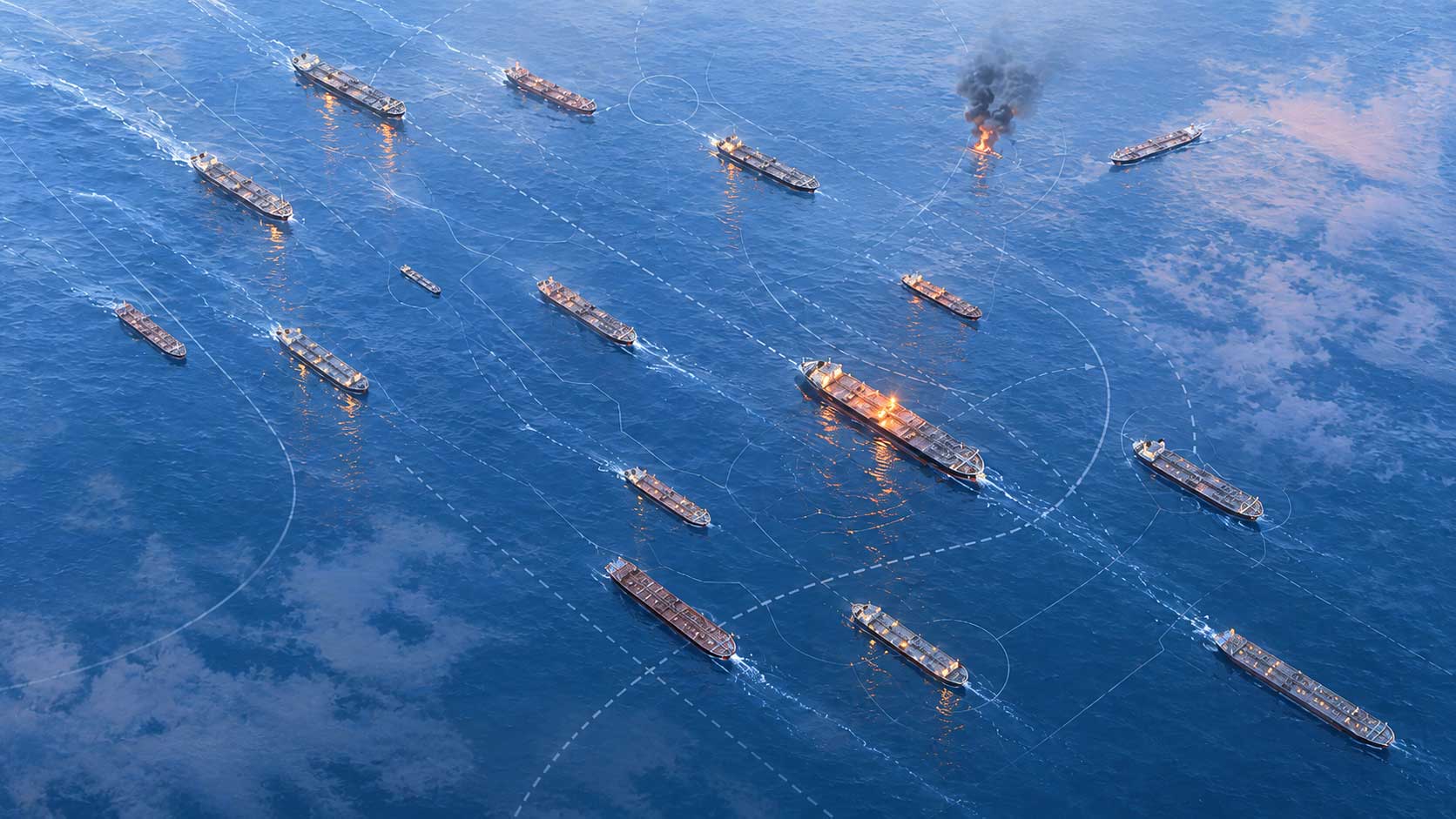
Ukraine’s Unmanned Systems Forces struck 21 vessels in the Sea of Azov between 5 and 8 July 2026, of which 10 have been publicly identified. That leaves the operating fleet of the Azov-Crimea fuel corridor almost entirely intact. FleetLeaks ran a co-location analysis on Global Fishing Watch port-visit data to identify which other tankers share the corridor’s anchorages with the struck vessels. Seventy-seven candidate tankers surface. Some of them are already under Western sanctions and running under old AIS names. Most are not sanctioned by anyone.
The Russian-installed governor of occupied Crimea, Sergei Aksyonov, told Russian state media on 8 July that the peninsula’s fuel supply “remains tense and will continue for some time. On certain days there will be no fuel available to be freely sold.” Ukraine’s Ministry of Defence, on the same day, described its ongoing operations against Russian energy infrastructure as “long-range sanctions.” Between the two statements sits the fleet documented here.
Method: co-location analysis on port-visit data
The analysis proceeded in four stages. First, we identified seven of the ten struck vessels with confirmed MMSI numbers and pulled every port-visit event recorded for them by Global Fishing Watch inside the Sea of Azov basin (bounding box 34.5°E to 39.5°E, 45.0°N to 47.5°N) between April 2025 and July 2026. Second, for each of those port visits, we searched for other vessels that visited the same anchorage within a ±48-hour window. Any vessel that appeared in that window was recorded as a co-location.
Third, we ranked all vessels by their total co-location count with the seven struck vessels across all Azov anchorages. Vessels with three or more co-locations advanced. Two hundred and ninety-five candidates surfaced. Fourth, we filtered those candidates to tanker-type vessels using VesselFinder’s ship-type field, leaving 77 tanker candidates. Each was then enriched via Equasis to identify current ownership, ISM manager, and classification-society history.
Co-location does not by itself confirm commercial coordination. Two vessels calling at the same anchorage within 48 hours may simply be shipping to unrelated buyers. However, when a vessel co-locates with multiple different struck vessels, at multiple different anchorages, over an extended period, the pattern becomes progressively more suggestive of a shared operational network. All 77 vessels documented here co-located with at least three of the seven struck vessels at Azov corridor anchorages within the analysis window.
The corridor as it stands right now
The interactive map below plots each candidate tanker at its most recent GFW-recorded position in the Sea of Azov basin. Struck vessels are shown in red. Candidate tankers with existing Western sanctions designations are shown in orange. Undesignated candidate tankers are shown in yellow. Solid fill indicates a documented visit within the last 30 days; muted fill indicates the last visit occurred earlier within the 90-day window.
Forty-five of the 77 candidate tankers have a GFW-recorded port visit within the last 90 days. The remaining 32 have not appeared in GFW port-visit data over the same window. That absence may reflect AIS transponder shutdown, extended lay-up, or simply routes that stopped short of a named anchorage. GFW’s port-visit detection requires an AIS signal at an anchorage boundary, and the closed Sea of Azov basin is known to have sparse AIS coverage compounded by systematic Russian electronic-warfare suppression. Both mechanisms undercount actual activity in the region.
A distinctive pattern surfaces in the anchorage breakdown: the majority of most-recent positions cluster at unnamed offshore anchorages in the basin instead of at named terminals. Vessels appear to loiter mid-basin instead of docking at Rostov, Taganrog, Yeysk, or Kerch directly. That behaviour is consistent with attempted attributability reduction: an offshore loiter does not appear in port-authority records the way a named-terminal call does.
AIS name spoofing: sanctioned vessels running under old names
Cross-referencing the AIS names transmitted by the candidate vessels against their registered names in Equasis reveals a systematic pattern. Nine vessels on the corridor are transmitting AIS identities that do not match their current registered names. In every documented case, the AIS transponder retains an older identity while the vessel’s registered name has changed.
- Sanar-9 (IMO 9300350, US OFAC sanctioned April 2023, EU sanctioned September 2025) transmits AIS as AVRORA REGUL.
- Ivan Kramskoy (IMO 9640499, EU and Canada sanctioned October 2025) transmits AIS as VF TANKER-1.
- Sanar 18 (IMO 9645011, EU sanctioned July 2025, Canada June 2026) transmits AIS as VF TANKER-12.
- Vasily Polenov transmits AIS as VF TANKER 9.
- Isaac Levitan transmits AIS as VF TANKER-19.
- Sanar-10 (IMO 9300348, US OFAC sanctioned April 2023) transmits AIS as YAROSLAVL.
- BM Flot-1 transmits AIS as VF TANKER-5.
- BM Flot-3 transmits AIS as VF TANKER-15.
- Aleksey Savrasov (IMO 9645061, hit 6-7 July, EU sanctioned October 2025) still transmits AIS as VF TANKER-17.
The pattern is consistent. Vessels of the Volga Shipping fleet were formally renamed from generic VF-Tanker identifiers to Russian cultural-figure names (painters, admirals, poets) in a rebranding batch during 2023. The registered names on Equasis reflect the new identities. The AIS transponders continue to transmit the old names. Whether that constitutes deliberate identity manipulation or simply a delayed update of transponder configurations, the practical effect is the same: a vessel already designated by Western sanctions authorities under one name continues to appear in AIS-based tracking systems under an older identity that carries no such flag.
The operators behind the corridor fleet
Equasis ownership and management data resolves the 77 candidate tankers into a small number of distinct commercial operators. Six ISM managers account for a large majority of the fleet.
| ISM manager | Vessels in candidate set | Fleet role | Vessels struck 5-8 July |
|---|---|---|---|
| Ilya Muromets JSC | 7 | Russian cultural-figure named tankers (Vasily Polenov, Vasily Surikov, Valentin Serov, Isaac Levitan, Nikolai Dubovskoy, and others). Successor operator to the Volga Shipping VF-Tanker series. | Aleksey Savrasov (formerly Vf Tanker-17) |
| Volgaenergomarin LLC | 6 | Tethys, Dafne, Elektra, Calliope, Garmonia, Japetus. Not previously documented as a distinct corridor operator in FleetLeaks tracking. | – |
| Rosewood Shipping LLC | 5 | Operates the Sanar 2, 3, 9, 10, and 18. Same operator as the struck Sanar-1, Sanar-17, and Sanar-4. | Sanar-1, Sanar-4, Sanar-17 |
| Eneya LLC | 5 | Magomed Gadzhiev, Nizami Ganjavi, Armada Leader, Oleg Pervak, Akhty. | – |
| Prime Shipping LLC-Rus | 3 | Aura, Liberty, Loyalty. Same operator as struck vessels Teti, Penelope, and Climene. | Teti, Penelope, Climene |
| BM Flot LLC | 3 | Lady Rania (UK, US, EU, Canada sanctioned since 2022), BM Flot-1, BM Flot-3. | – |
Three operators – Ilya Muromets, Rosewood, and Prime Shipping – account for 15 candidate vessels and six of the 10 struck vessels. That concentration is the substantive finding: the Azov-Crimea corridor is not run by a diffuse marketplace of anonymous shell operators. It is run by a small number of identifiable Russian commercial entities, each managing a coherent fleet of similar-class Handysize product tankers.
Of these six operators, only one – the registered owner and operator of Lady Rania – has any direct Western sanctions attachment through its ownership structure. Ilya Muromets JSC, Rosewood Shipping, Prime Shipping LLC-Rus, Volgaenergomarin, Eneya, and BM Flot LLC operate without Western sanctions designation at the corporate level, notwithstanding the ownership of vessels that carry Western designations at the vessel level. The corridor’s commercial infrastructure is largely intact regardless of what happens to individual vessels within it.
Twelve vessels have lost their IACS classification
Equasis classification-society records show that 12 of the 77 candidate tankers withdrew from a member society of the International Association of Classification Societies (IACS) after February 2022. In every documented case, the vessel subsequently classed with the Russian Maritime Register of Shipping. IACS member societies (which include DNV, Lloyd’s Register, ABS, ClassNK, RINA, Bureau Veritas, and others) provide the classification services most Western marine insurance underwriters require. Loss of IACS class effectively removes a vessel from Western marine insurance markets and forces reliance on Russian domestic underwriting.
The IACS-withdrawal signal is a durable shadow-fleet marker. It is documented in Equasis classification tables and independent of any AIS activity. A vessel with an IACS withdrawal, Russian flag, Russian ISM manager, and repeated visits to Azov corridor anchorages is definitionally a shadow-fleet asset – regardless of whether any Western jurisdiction has designated it.
The wider picture
The July 5-8 Azov Sea strikes were the naval component of a wider Ukrainian campaign against Russia’s fuel supply. In the same 72 hours, Ukrainian long-range drones struck the Omsk oil refinery in western Siberia – Russia’s largest by processing capacity, at approximately 2,500 kilometres from the Ukrainian border. Reuters reported the following day that the refinery had halted operations. Ukraine’s General Staff described the Omsk hit as “the last of the 11 largest gasoline producers in Russia that have been hit.” The same period recorded strikes on the Slavneft-Yanos refinery at Yaroslavl, the Novatek Ust-Luga complex on the Baltic, and the Kaluga Oblast First Plant refinery.
Novaya Gazeta Europe estimated on 2 July that fuel supply issues had been reported in 78 of Russia’s 83 federal regions, plus occupied Crimea and Sevastopol. Thirty-eight regions have imposed civilian fuel sales restrictions. Five have declared a state of emergency: occupied Crimea and Sevastopol (26 June), Penza Oblast, Irkutsk Oblast, and Zabaykalsky Krai. Russia has begun importing petrol from Belarus and India to offset the shortfall.
The maritime intelligence firm Ambrey, on 8 July, warned of a heightened threat of direct kinetic Russian action against Ukraine-linked shipping at the Sulina Anchorage over the coming days. That forecast remains open as of publication.
The Azov-Crimea corridor sits at the intersection of these developments. It supplies fuel to a peninsula under state-of-emergency conditions. It is operated by a small number of identifiable Russian commercial entities. Its vessels transit sparse-AIS waters where identity spoofing has become routine and classification-society withdrawal is common. Ukraine’s Unmanned Systems Forces have demonstrated the operational capability to strike vessels on this corridor at an industrial rate. The 77 tankers documented here are the operating fleet those strikes will need to address for the corridor’s supply role to end.
The unnamed strike victims
Eleven of the 21 vessels reported struck between 5 and 8 July remain publicly unnamed. Nine tankers hit on the night of 7-8 July have not been publicly identified. One cargo ship and one ferry struck on 6-7 July have not been named beyond their vessel type. FleetLeaks has no independent identification of these vessels at time of publication.
Given the operator concentration documented above, the unnamed strike victims are likely drawn from the same pool of vessels documented in this analysis. Any subsequent identification by maritime intelligence firms, Ukrainian military sources, or open-source investigators will be checked against the candidate set and this article updated accordingly.
Why FleetLeaks documents this
The Russian shadow fleet is the operational infrastructure through which Russia funds and sustains its war against Ukraine. Oil-export revenues underwrite the war’s budget. Fuel deliveries sustain the military occupation of Ukrainian territory. Vessels moving fuel through the Azov-Crimea corridor are the maritime component of that infrastructure at the point closest to the war’s ongoing front.
The commercial entities that own and manage those vessels operate without Western sanctions designation, in most cases. Their vessels frequently transmit AIS identities that do not match their registered names. Many have withdrawn from IACS classification and operate on Russian-domestic marine insurance. The regulatory tools built for detecting and constraining shadow-fleet activity in the wider maritime commons work poorly against a fleet that stays domestic, stays Russian-flagged, and rarely leaves the enclosed basin between Rostov and Kerch.
Ukraine’s Unmanned Systems Forces have demonstrated a capability to reach these vessels through means that the sanctions regime has never approached. This piece documents what is on the water for the operating side of that engagement. Whether the corridor’s tankers continue moving fuel to occupied Crimea depends on decisions being made in Moscow and Kyiv. FleetLeaks documents what those decisions are made against.
Sources
- Global Fishing Watch – Port-visit events (dataset: public-global-port-visits-c2-events:latest) queried via the GFW API v3 for the Sea of Azov bounding box, April 2025 to July 2026, providing the co-location dataset that anchors this analysis. globalfishingwatch.org
- Equasis – Vessel management, ownership, classification-society, and inspection data for each of the 77 candidate tankers. equasis.org
- VesselFinder – Ship-type classification used to filter co-located vessels to tanker types. vesselfinder.com
- OpenSanctions – Cross-jurisdictional sanctions cross-check across US OFAC, EU, UK OFSI, Canada SEMA, Australia DFAT, New Zealand, and Switzerland SECO. opensanctions.org
- FleetLeaks – The Azov Sea Tanker Strikes: Vessel-by-Vessel Analysis of the 5-8 July 2026 Campaign, the companion piece documenting the strike targets themselves
- Seatrade Maritime News – “Ukraine hits 21 Russian ships within 72 hours“ including Ambrey’s Equasis-aligned vessel identifications and the Sulina Anchorage retaliation forecast
- Reuters via Global Banking and Finance – “Russian-backed Crimea governor: fuel situation likely to remain tense“, 8 July 2026, with Aksyonov’s statement on continuing shortages
- Kyiv Independent – “Russia’s largest oil refinery in flames as Ukraine strikes Omsk“, on the parallel long-range component of the campaign
- The Moscow Times – “Regionwide Blackout Hits Crimea After Ukrainian Strikes“
- Kyiv Post – “Ukraine’s 3,000-km Drone Strike Halts Russia’s Largest Refinery“, with reporting on the Omsk shutdown
- Novaya Gazeta Europe – “Petrol shortages have been reported in at least 78 regions of Russia and Crimea”, 2 July 2026, on the geographic spread of the fuel crisis
- Al Jazeera – “The crisis is deep: The view from Russia as fuel shortages worsen“, on Russia’s petrol imports from India and Belarus
- KSE Institute (Kyiv School of Economics) – “Emerging and Unsanctioned Russian Shadow Fleet Tankers” by Anatolii Kravtsev and Yuliia Pavytska (September 2025), the analytical framework for identifying documented shadow-fleet actors without Western designation
- Ukraine’s Unmanned Systems Forces – Robert “Madyar” Brovdi’s Telegram statements identifying the vessels struck between 5 and 8 July. t.me/robert_magyar