
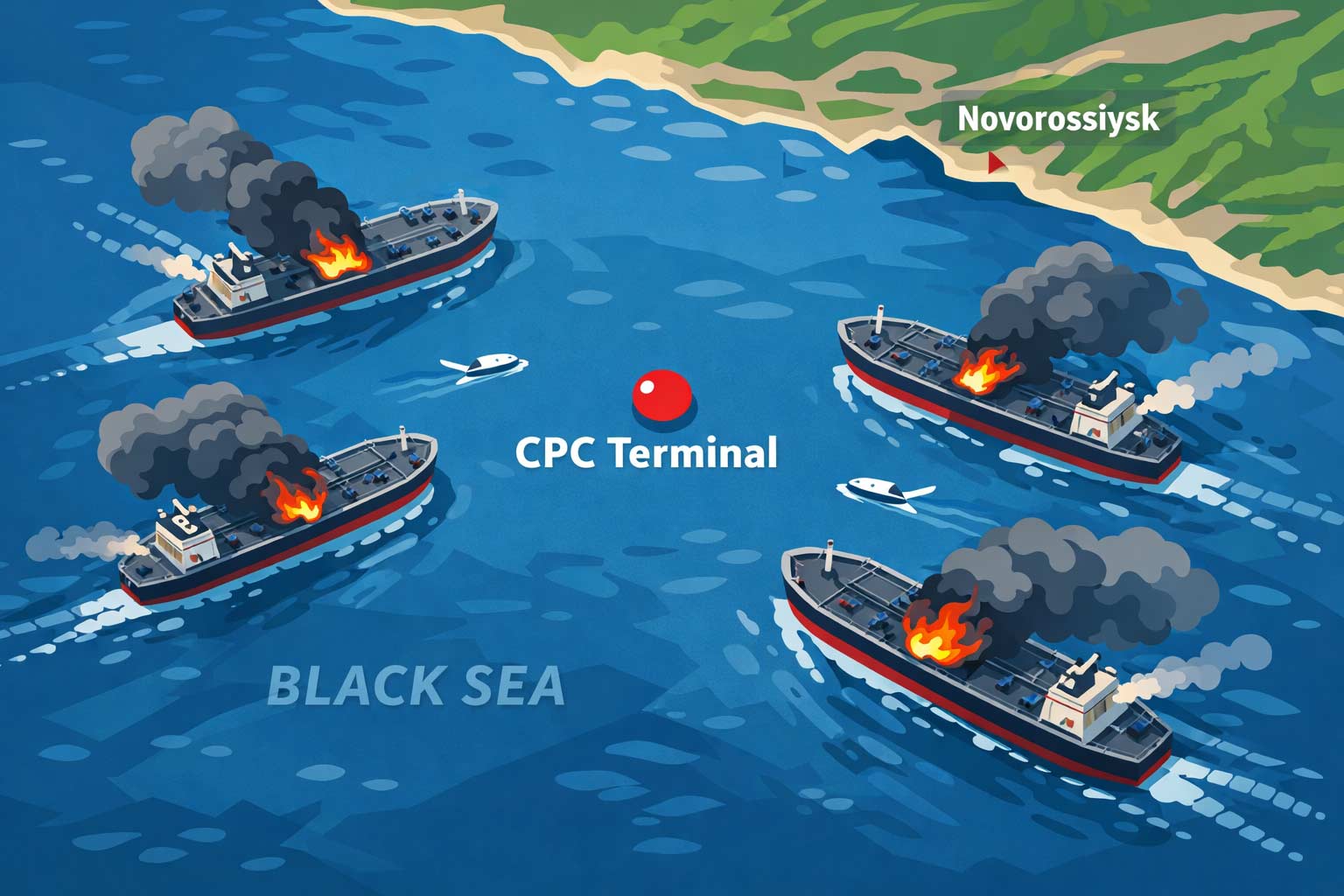
Several oil tankers heading toward Russia’s Black Sea coast were struck by drones this week while positioning to load Kazakh crude, according to sources cited by Reuters, adding to mounting security concerns around one of the region’s most important export corridors.
The incidents occurred near the offshore terminal operated by the Caspian Pipeline Consortium (CPC), the primary outlet for Kazakhstan’s seaborne oil exports. Four Greek-managed crude oil tankers were named by sources as being affected while operating offshore near the loading area.
The strikes come as Kazakhstan’s oil output dropped sharply in early January, with exporters struggling to move crude through Russia amid winter storms, earlier infrastructure damage, and a deteriorating security environment in the Black Sea.
Drone Strikes Reported as Tankers Wait Near CPC Export Terminal
Sources told Reuters that unidentified drones struck the tankers on Tuesday as they waited near the CPC terminal off Russia’s coast. Two maritime security sources said a fire broke out on one vessel but was quickly extinguished.
Attribution remains unclear. Ukrainian authorities did not comment on the incidents, and the Caspian Pipeline Consortium declined to respond to requests for comment. No injuries were reported among the crews.
The location of the strikes is notable. The vessels were not transiting the Black Sea but waiting close to the CPC loading area, which had already been disrupted by a Ukrainian drone attack in late November that damaged one of the terminal’s offshore moorings and temporarily halted exports.
Four Greek-Managed Tankers Named by Sources
MATILDA
Crude oil tanker
IMO: 9407457
Built: 2009
Deadweight: ~158,000 tonnes
Manager: Thenamaris (Greece)
Status at time of incident: In ballast, waiting to load at CPC
Reported damage: Two drone strikes; minor, repairable deck damage confirmed by operator
Crew: No injuries reported
DELTA HARMONY
Crude oil tanker
IMO: 9408463
Built: 2009
Manager: Delta Tankers (Greece)
Status at time of incident: Approaching CPC loading area
Reported damage: Drone strike; brief onboard fire reported and extinguished
Crew: No injuries reported—
DELTA SUPREME
Crude oil tanker
IMO: 9585895
Built: 2018
Manager: Delta Tankers (Greece)
Status at time of incident: Operating offshore near CPC terminal
Reported damage: Listed among vessels struck by drones; extent of damage not publicly detailed
Crew: No injuries reported
FREUD
Crude oil tanker
IMO: 9804461
Flag: Marshall Islands
Built: 2018
Manager: TMS Tankers (Greece)
Status at time of incident: Waiting offshore near CPC terminal
Reported damage: Listed among vessels struck; damage details not disclosed
Crew: No injuries reported
CPC: A Critical Export Chokepoint for Kazakh Crude
The Caspian Pipeline Consortium terminal near Novorossiysk handles the majority of Kazakhstan’s oil exports shipped by sea. Crude from major fields such as Tengiz and Kashagan is transported through a 1,500-kilometer pipeline system before being loaded onto tankers offshore.
Although the terminal is located on Russian territory, much of the oil it exports belongs to Kazakhstan and international partners. CPC shareholders include Kazakhstan’s state oil company, Russian firms, and Western energy majors such as Chevron and ExxonMobil.
Any disruption near the terminal—whether to infrastructure or vessels waiting offshore—has immediate consequences for export volumes and shipping schedules.
Kazakhstan’s Oil Output Slumps Amid Export Disruptions
Kazakhstan’s oil output fell by roughly 35% between January 1 and January 12, according to a source cited by Reuters. While winter weather constrained pipeline operations, security disruptions in the Black Sea compounded the decline.
Tankers waiting offshore have faced longer delays, creating congestion around the CPC loading area just weeks after the terminal itself was damaged in a separate drone attack.
Kazakh officials have previously criticized strikes affecting CPC operations, warning that they harm third-party interests and undermine the reliability of a key export route.
Commercial Shipping Drawn Deeper Into the Conflict
Ukraine has acknowledged targeting Russian energy infrastructure as part of its war effort, though it has not commented on the tanker strikes. Responsibility for the latest incidents remains unconfirmed.
What stands out is that the vessels involved were Greek-managed commercial tankers servicing Kazakh exports rather than Russian-flagged or sanctioned ships. The incidents suggest that risk in the Black Sea is no longer confined to ports and pipelines, but extends to vessels waiting offshore near critical infrastructure.
For shipowners and operators, the operating environment is changing. Serving Russia-linked export routes now carries exposure not only to regulatory and insurance challenges, but to direct security threats at sea.
Whether the returns justify that exposure is a question more operators may be forced to confront as tensions continue to spill into the Black Sea.
Reporting & References
- Reuters — “Drones hit three tankers in Black Sea as Kazakh oil production plummets, sources say” (January 13, 2026)
- Reuters — “Kazakhstan criticises Ukraine over drone attack on CPC oil terminal” (November 30, 2025)
- Reuters — Company confirmation from Thenamaris regarding Matilda damage and crew status (January 13, 2026 reporting)
- Business Insurance — “Drones hit tankers in Black Sea as Kazakh oil production falls 35%”
- Safety4Sea — Background on Black Sea maritime security risks and drone incidents
- AIS / Vessel Tracking Data — Vessel movements and positioning near the CPC terminal (Matilda IMO 9407457, Delta Harmony IMO 9408463, Delta Supreme IMO 9585895, Freud IMO 9804461)