
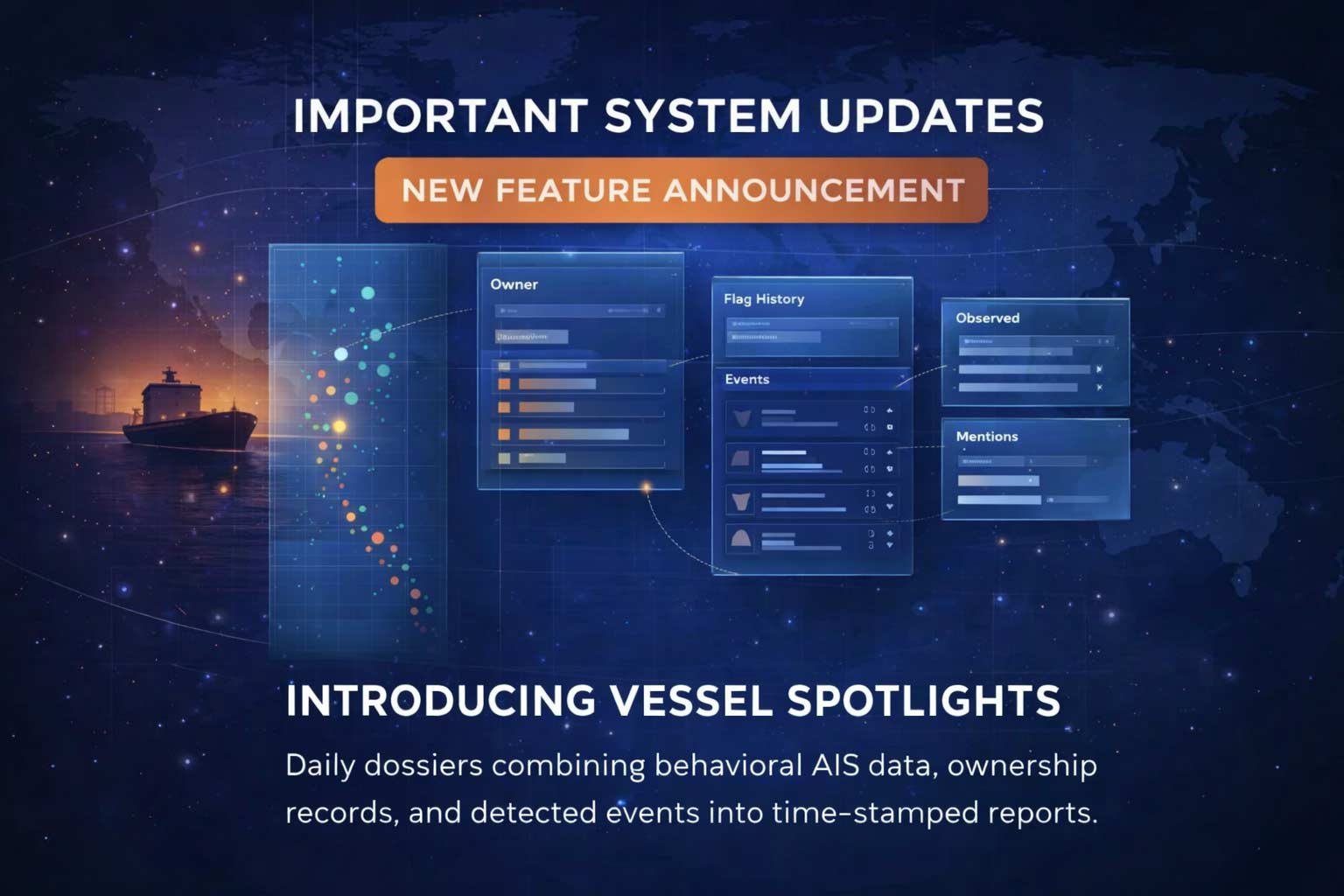
Each day, FleetLeaks observes hundreds of cargo tankers transmitting AIS signals across sanctioned and high-risk maritime zones. Some vessels display routine traffic patterns. Others accumulate repeated indicators such as prolonged loitering, signal gaps, or frequent proximity to other tankers.
To surface these cases consistently, FleetLeaks now publishes a daily Vessel Spotlight: an algorithmically selected, fully sourced dossier on a single vessel, generated every morning from AIS behavioral analysis, registry records, and public sources.
What a Vessel Spotlight Is
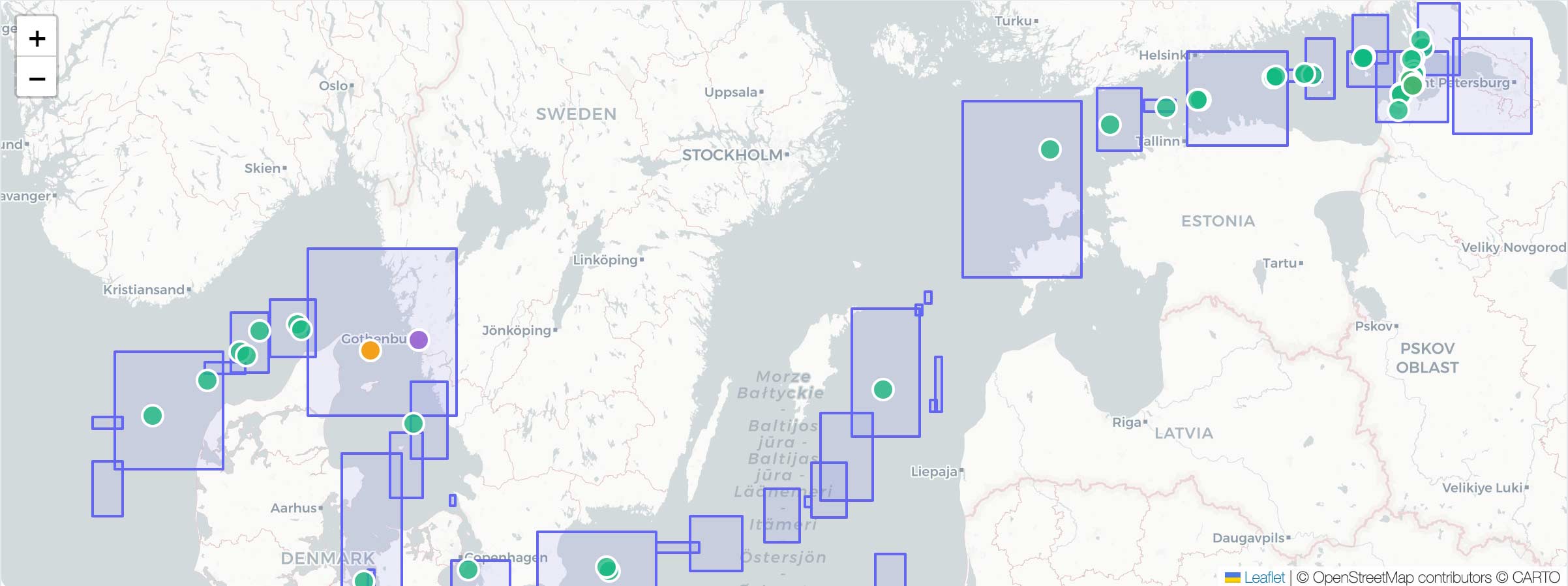
A Vessel Spotlight is a self-contained behavioral profile of one vessel. Selection is fully algorithmic. A scoring pipeline evaluates every cargo tanker in the FleetLeaks AIS event database, weighting ship-to-ship proximity detections, AIS signal gaps, loitering patterns, and zone dwell time across a rolling 90-day window.
Each day, the vessel with the highest behavioral score that has not been featured in the prior 30 days is selected. It does not need to be sanctioned. It does not need to be under investigation. The only criterion is observable AIS activity that warrants closer examination.
Each dossier is published as a standalone page at fleetleaks.com/vessel-spotlight, with underlying data, sources, and methodology visible on the page.
What Goes into Each Vessel Dossier
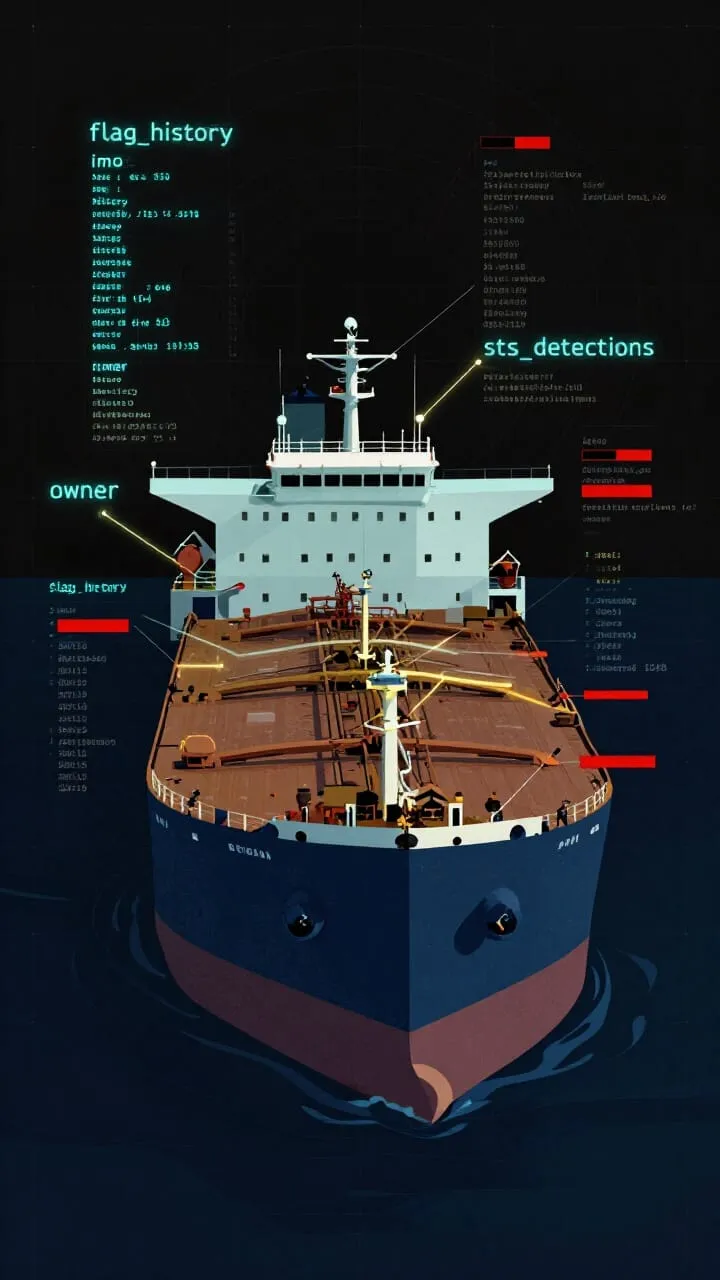
AIS behavioral data forms the core. The pipeline tallies ship-to-ship proximity detections, AIS gaps, loitering events, and zone dwell periods across monitored regions. These indicators are derived from AIS position broadcasts as defined by the International Maritime Organization. They describe what receivers observed, not what a vessel intended.
Ownership and management records are pulled from Equasis, GISIS, and commercial registries. Registered owner, ISM manager, ship manager, and commercial manager are documented where available. When beneficial ownership disclosures are absent, that absence is explicitly noted.
Company research goes beyond listing names. Each registered owner, ISM manager, and commercial manager identified through Equasis or GISIS is run through an automated research stage. The pipeline gathers incorporation details, fleet size, jurisdictional presence, and any public reporting on the entity. A single-vessel shell company registered in a free zone reads differently in context than a diversified tanker operator with a 30-year track record. Both are documented with the same rigor.
Flag and name change history is compiled from Equasis and cross-referenced with VesselFinder. Registry stability and frequency of changes are presented as timelines, allowing readers to draw their own conclusions.
Port and terminal proximity is derived from AIS detections near known terminals. FleetLeaks reports where a vessel was observed, not where it claimed to have called.
Public mentions are gathered through automated search across news sources, maritime publications, government notices, and investigative reports. The pipeline queries vessel names, IMO numbers, MMSI identifiers, and known aliases across multiple search APIs, then deduplicates and attributes each result with URL, publication date, and source. A vessel that appeared in a Lloyd’s List investigation last week will surface differently in the dossier than one with no public footprint at all. All mentions are cited with source links so readers can verify independently.
Sanctions status is checked against lists published by the US Treasury (OFAC), the EU, UK, Canada, Australia, and New Zealand. The dossier states whether a vessel appears on any current list and specifies which jurisdictions were checked.
Each section includes short AI-generated summaries grounded strictly in the data above. Prompts enforce hard constraints: no speculation about intent, no implication of wrongdoing, and no conclusions beyond what the inputs support.
Why Non-Sanctioned Vessels Appear in Vessel Spotlights
Sanctions designations reflect evidence that has already been collected, reviewed, and acted on by governments. That process takes time. Vessels exhibiting high-frequency behavioral signals often appear before any formal designation exists.
FleetLeaks tracks hundreds of sanctioned vessels. It also monitors several hundred more that show repeated AIS behavioral indicators in sanctioned zones without appearing on any list. These vessels are often the ones compliance teams and researchers need early visibility on.
A designation is a legal conclusion. A Vessel Spotlight is an analytical input. FleetLeaks provides the latter so readers can evaluate the evidence independently.
How to Use Vessel Spotlights
Journalists can cite Vessel Spotlights as structured collections of public-record signals. Every claim links back to an observable input. These dossiers are not allegations.
Compliance teams can use a Vessel Spotlight as an initial screening reference. Behavioral indicators, ownership chains, and registry history mirror inputs commonly used in enhanced due diligence workflows.
Researchers benefit from methodological consistency. The same scoring weights, data sources, and constraints apply across the archive, enabling longitudinal analysis.
Data Currency and Refreshes
Each Vessel Spotlight reflects data available as of its publication date. AIS feeds, sanctions lists, and registry records change over time.
The same automated pipeline can be re-run to generate an updated dossier for any previously featured vessel. This refresh covers compute and data access costs. Methodology and scoring thresholds remain unchanged.
All original daily Vessel Spotlights remain free and publicly accessible in the archive.
What Comes Next
A new Vessel Spotlight publishes every day. Over time, the archive becomes a longitudinal record of behavioral patterns across the monitored fleet.
The selection algorithm is already evolving. We now track daily score snapshots to detect momentum, surfacing vessels whose behavioral scores have shifted sharply overnight. Vessels that appear in the top rankings for the first time receive a novelty boost. Automated newsworthiness screening checks whether top candidates have appeared in recent public reporting, and recently designated vessels receive priority. The final pick uses weighted randomness across the top candidates, so daily selections stay varied without sacrificing analytical quality.
Any methodology changes will be documented publicly. Community feedback is valuable to us. If you spot a sourcing gap, a data quality issue, or have suggestions for vessels worth watching, reach out by DM on Bluesky or X, or through our contact page. Follow us on either platform for daily Spotlight announcements and maritime sanctions updates.