
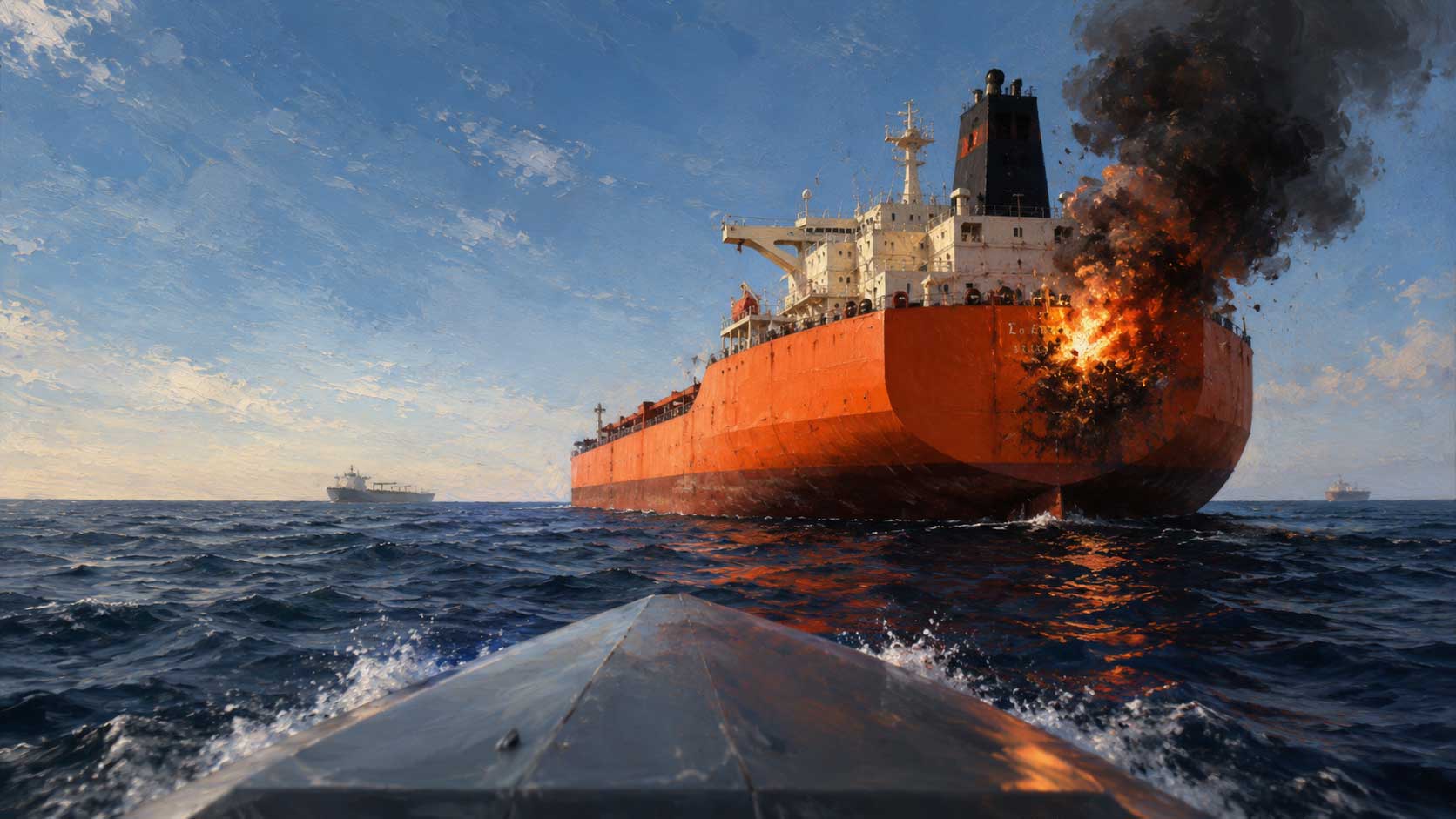
Ukraine’s Security Service (SBU) says its Mamai naval drones, working with the Ukrainian Navy, struck two Russian shadow-fleet crude tankers, Louise 1 (IMO 9290323) and Banda (IMO 9337406), in the Black Sea on 16 July 2026. The strikes were reported by Interfax Ukraine, Ukrainska Pravda, and APA. The SBU also said Russian aircraft attempted to engage the drones with machine-gun fire and bombs without success. FleetLeaks has no independent damage assessment for either vessel at time of publication.
The two vessels are structurally different from the small Handysize product tankers Ukraine’s Unmanned Systems Forces has struck in the Sea of Azov corridor campaign. Louise 1 is a 159,000 DWT Suezmax-class crude tanker; Banda is a 106,000 DWT Aframax.
They sit in the Russian oil-export layer of the shadow fleet, while the Azov campaign has focused on Crimea supply traffic. They operate under different flags, different management structures, and a different classification-society playbook than the Azov corridor fleet. FleetLeaks holds Equasis data on both.
Louise 1: 3 million tonnes of Urals in seven months
Louise 1 (IMO 9290323, MMSI 351800000) is a Panama-flagged Suezmax crude tanker built in 2004. Length overall approximately 274 metres, deadweight approximately 159,092 tonnes. Ukraine’s SBU reported that in 2026 alone, through mid-July, Louise 1 transported nearly 3 million tonnes of Russian Urals crude oil, exported from Baltic and Black Sea Russian ports with the vessel’s automatic identification system switched off during transit. Ukraine’s War and Sanctions portal (maintained by GUR) documents Louise 1’s shadow-fleet role and records the vessel’s Ukrainian sanctions designation on 12 February 2026.
FleetLeaks Equasis data on Louise 1 records the vessel’s current management structure as:
- Ship manager: Bainbridge DMCC (Dubai, United Arab Emirates)
- ISM manager: Superfleet DMCC (Dubai, United Arab Emirates)
- Registered owner: Mati Shipping SA (Panama)
- Current classification: Bureau Veritas (IACS member)
- Prior classification: American Bureau of Shipping (IACS, subsequently withdrawn)
The management structure is a documented shadow-fleet pattern: Dubai-based operational management with a Panamanian shell as registered owner. Louise 1 remains inside the IACS system, currently classed with Bureau Veritas. That distinguishes her operator playbook from the Azov corridor vessels, many of which have withdrawn from IACS entirely and moved to the Russian Maritime Register of Shipping. A vessel that remains inside IACS classification can preserve access to marine insurance, foreign port calls, and counterparties that would be harder to reach after a full move into Russian or non-IACS class. The Azov corridor vessels, which operate almost entirely within Russian domestic and occupied Ukrainian waters, face a different set of constraints.
As of the checks used for this article (against the OpenSanctions cross-jurisdictional aggregator and the FleetLeaks sanctions dataset), neither Bainbridge DMCC, Superfleet DMCC, nor Mati Shipping SA appeared on any sanctions list. The vessel itself carries only a Ukrainian designation. No Western jurisdiction (US, EU, UK, Canada, Australia, New Zealand, Switzerland) has designated Louise 1 or her listed management entities at time of publication.
Banda: mainstream management, classification-society shuffle
Banda (IMO 9337406) is a Liberia-flagged Aframax/LR2 crude tanker built in 2007. Length overall approximately 238 metres, deadweight approximately 105,576 tonnes. Ukrainian reporting records Banda transporting Russian crude oil from Ust-Luga, Kerch, Novorossiysk, and Nakhodka. FleetLeaks Equasis records show:
- Ship manager: Fleet Management Ltd (Hong Kong)
- ISM manager: Fleet Ship Management Pte Ltd (Singapore)
- Registered owner: Crude Petroleum Ventures SA (Panama, c/o Fleet Management Ltd Hong Kong)
- Current classification: Registro Italiano Navale (IACS, entered 26 August 2025)
- Prior classification: DNV (IACS, delivered until 30 May 2022), Lloyd’s Register (IACS, delivered from 10 September 2007 through DNV transition)
Banda‘s classification history documents a specific pattern. She left DNV, a Norwegian IACS society, on 30 May 2022, just over three months after Russia’s full-scale invasion of Ukraine. She subsequently entered Registro Italiano Navale, an Italian IACS society that has appeared repeatedly in reporting and vessel records involving Russia-linked tanker trades since 2022. That is a classification-shuffle pattern documented across the export shadow fleet: vessels move from Northern European IACS societies to RINA (or, less commonly, to non-IACS Russian classification) as their trading patterns become incompatible with the Northern European societies’ compliance policies. Banda‘s management is mainstream (Fleet Management Ltd is one of the world’s largest third-party ship managers, based in Hong Kong), and does not carry a shadow-fleet signature at the entity level. The vessel’s role as a Russian oil carrier is achieved through the ownership shell (Crude Petroleum Ventures SA) and the classification arbitrage.
Like Louise 1, Banda carries no Western sanctions designation, only Ukrainian.
The parallel campaign: SBU sea drones and the export tanker fleet
The Louise 1 and Banda strikes are the third documented SBU sea-drone operation against export shadow-fleet tankers in the last ten days. On 8 July 2026, the SBU used a Sea Baby drone to strike the Suezmax tanker Blue near occupied Yalta inside Ukraine’s exclusive economic zone; Blue is EU, UK, Switzerland, Canada, Australia, New Zealand, and Ukraine sanctioned. On 17 June 2026, Ukrainian Defence Forces struck an earlier Black Sea tanker under EU, Switzerland, UK, Canada, and Ukraine sanctions. The 16 July Louise 1 and Banda strikes bring the visible Black Sea sea-drone campaign to three confirmed operations against four vessels over one month.
The Black Sea sea-drone operations run in parallel with the Sea of Azov aerial-drone campaign FleetLeaks has documented separately, but the two are analytically distinct. Different Ukrainian agency (SBU vs. Unmanned Systems Forces / SBS), different platform class (naval drones vs. aerial drones), different theatre (open Black Sea vs. enclosed Sea of Azov), different vessel class (Suezmax/Aframax export tankers vs. Handysize corridor tankers), and different targeting logic (Russian oil export revenue vs. Crimea fuel supply). Together, the two campaigns place pressure on different parts of Russia’s maritime oil logistics chain, from Baltic and Pacific loading terminals through to occupied Crimea.
Ukrainska Pravda’s reporting on the 16 July strikes describes the combined tempo of Ukrainian operations as having “reached or even exceeded the intensity of the tanker war between Iran and Iraq” of the 1980s. The Iran-Iraq tanker war saw approximately 546 vessels attacked over eight years between 1980 and 1988. FleetLeaks uses that comparison as a scale marker and treats the current Ukrainian campaign as a separate case with different platforms, targets, geography, and legal context.
Retaliation as context
Russia has already retaliated against non-Russian civilian shipping in the Black Sea. On 22 June 2026, Russian forces attacked three foreign-flagged civilian cargo ships; the Turkish-owned, Panama-flagged bulk carrier Victress was hit worst, with a 58-year-old Egyptian cook killed and two Turkish crew injured. Ambrey’s 8 July maritime security advisory forecast a heightened threat of further Russian retaliation against Ukraine-linked shipping at the Sulina Anchorage. As of 16 July, no additional confirmed retaliation strikes on foreign civilian tonnage have been publicly reported. Ukraine’s Deputy Prime Minister Oleksii Kuleba’s 26 June letter to the International Maritime Organization argues that Russian shadow-fleet tankers may fall outside the protections international maritime law affords to ordinary civilian shipping; that framing applies to both the Azov corridor and Black Sea export tanker strikes.
Why FleetLeaks documents this
Louise 1 exported nearly 3 million tonnes of Russian crude in the first seven months of 2026 with her AIS transponder off. At Urals discount pricing that is on the order of one and a half billion United States dollars of revenue for the Russian state budget, moved on a single Panama-flagged Suezmax operated out of Dubai. She is not designated by any Western jurisdiction. She was struck on 16 July by a Ukrainian naval drone.
FleetLeaks tracks the Russian shadow fleet because that fleet is the operational infrastructure through which Russia converts oil into war financing. The Western sanctions regime has left large parts of the export fleet undesignated, in particular vessels operated through Dubai management shells and Panamanian owner shells. Ukraine’s SBU has demonstrated the operational capability to reach those vessels through means the sanctions regime has not approached. Documented here, at the vessel and operator level, is what those means are now being applied against.
Sources
- Interfax Ukraine – SBU sea drones strike Russian shadow fleet tankers Louise 1 and Banda in Black Sea, 16 July 2026
- Ukrainska Pravda – Ukrainian drones hit two Russian shadow fleet tankers in Black Sea, 16 July 2026, including the Iran-Iraq tanker war framing
- APA – SBU confirmed the strike on two more tankers of Russia’s shadow fleet in the Black Sea, 16 July 2026
- Ukrainska Pravda – Ukrainian Security Service drone hits Russian shadow fleet tanker in Black Sea – video, 8 July 2026, on the SBU Sea Baby drone strike on the Blue tanker
- Militarnyi – Sea Baby Naval Drone Strikes Sanctioned Tanker BLUE Near Yalta, 8 July 2026
- Kyiv Independent – Russia attacks foreign cargo ships in Black Sea, killing Egyptian sailor, 22 June 2026, on the Victress incident
- Ukraine War & Sanctions Portal (GUR) – war-sanctions.gur.gov.ua, Louise 1 entry documenting Ukrainian sanctions designation of 12 February 2026 and export volumes
- Equasis – equasis.org, vessel management, ownership, and classification-society history for both Louise 1 and Banda
- OpenSanctions – opensanctions.org, cross-jurisdictional sanctions cross-check confirming neither vessel nor any listed management entity carries Western sanctions designation
- FleetLeaks – The Azov Sea Tanker Strikes: Vessel-by-Vessel Analysis of the 5-8 July 2026 Campaign, on the parallel Sea of Azov corridor operations
- FleetLeaks – Still Plenty of “Fish”: The Shadow-Fleet Tankers Still Running the Azov Corridor, on the corridor’s operating fleet
- FleetLeaks – Ukraine’s 96-Hour Shadow-Fleet Campaign Reaches 35 Vessels, on the four-night SBS Azov campaign totals
- Seatrade Maritime News – Ukraine hits 21 Russian ships within 72 hours, including Ambrey’s Sulina Anchorage retaliation forecast