December 18, 2025
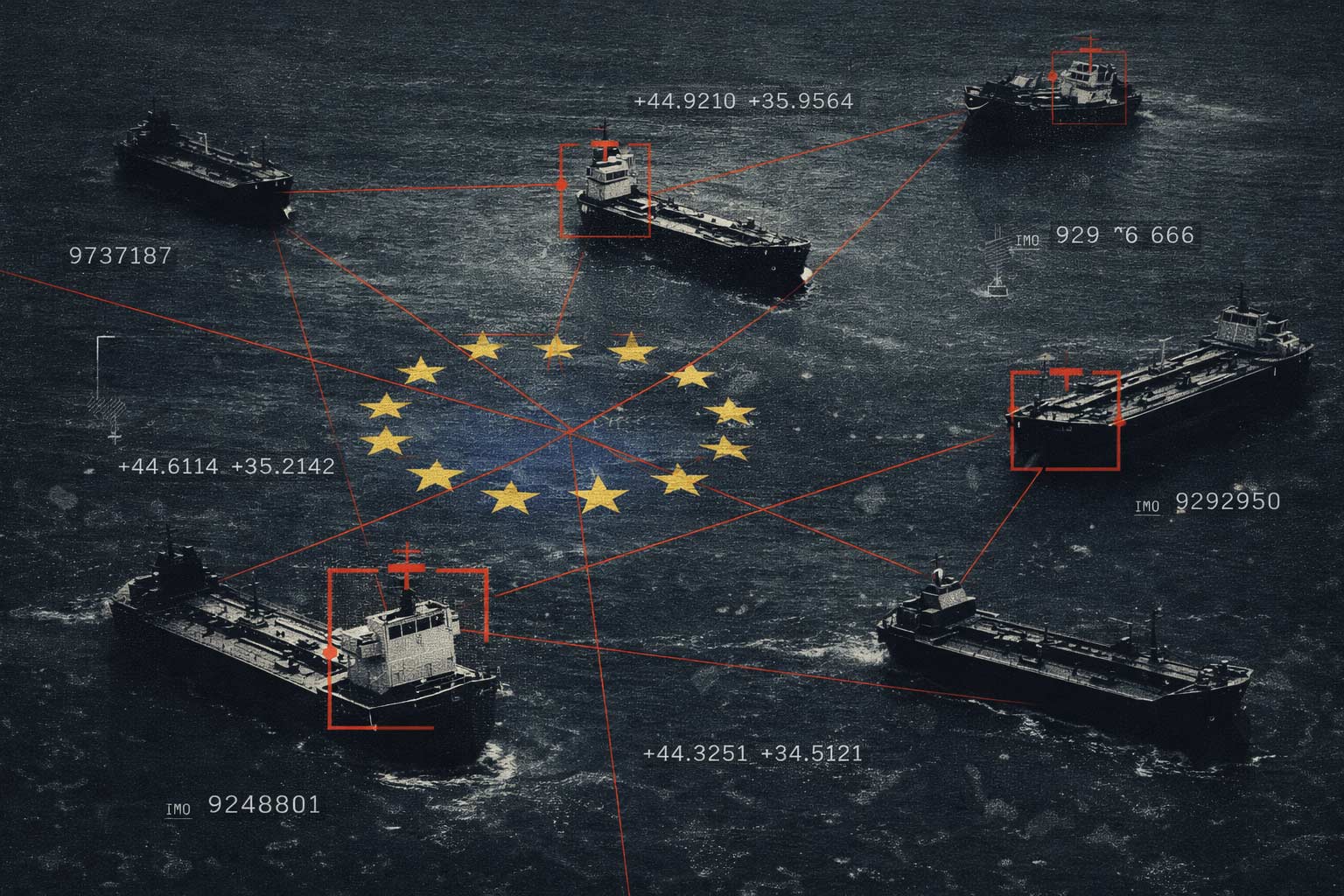
The EU added 41 vessels to its shadow fleet sanctions today, bringing its total to 597 — the largest list of any jurisdiction. But the headline number obscures what’s actually happening here.
These aren’t all oil tankers evading price caps. The list includes stolen grain carriers, Arctic oil shuttle tankers serving Gazprom’s Yamal operations, and an Iranian-flagged vessel shuttling between Iran and Russia. And it lands three days after the EU sanctioned the traders and shipping companies that manage many of these ships.
Here’s what the data actually shows.
The Grain Thieves: Matros Pozynich, Matros Koshka, Mikhail Nenashev
Three of the newly sanctioned vessels aren’t tankers at all. They’re bulk carriers — and they’ve been stealing Ukrainian grain since 2022.
imo-9573816/”>Matros Pozynich (IMO 9573816) and imo-9550137/”>Matros Koshka (IMO 9550137) made headlines in May 2022 when CNN published satellite imagery showing them loading grain at Sevastopol — Crimea’s main port, which produces almost no grain itself. The cargo came from occupied Ukrainian territory to the north.
Matros Pozynich tried to offload 30,000 tons of stolen wheat in Alexandria. Egypt turned it away after Ukrainian officials warned them. Lebanon refused it too. The ship eventually delivered to Latakia, Syria — Russia’s client state.
Ukraine’s GUR intelligence database documents that both vessels use a false AIS identity — broadcasting as “Maria Ermolova” — to mask their movements in and out of Crimea. On November 29, 2024, both ships were recorded in Sevastopol Bay under the same fake name simultaneously.
The third vessel, imo-9515539/”>Mikhail Nenashev (IMO 9515539), operates the same route. Ukraine’s Prosecutor General asked Turkey to investigate all three ships in June 2022.
All three are owned by subsidiaries of United Shipbuilding Corporation, Russia’s sanctioned state shipbuilding holding. Ukraine has issued arrest warrants for their captains.
These vessels aren’t evading oil price caps. They’re participating in what Ukraine calls systematic theft of agricultural products from occupied territory — one of the explicit criteria for EU vessel sanctions under Regulation 833/2014.
The Arctic Oil Infrastructure: Shturman Tankers
Five vessels in the new batch are Sovcomflot’s Arctic shuttle tankers built specifically for Gazprom Neft’s Yamal operations:
- imo-9752101/”>Shturman Ovtsyn (IMO 9752101)
- imo-9752096/”>Shturman Malygin (IMO 9752096)
- imo-9759927/”>Shturman Shcherbinin (IMO 9759927)
- imo-9759939/”>Shturman Koshelev (IMO 9759939)
- imo-9752084/”>Shturman Albanov (IMO 9752084) — sanctioned in February 2025
These are Arc7 ice-class tankers, capable of breaking through 1.8 meters of ice independently. They shuttle crude oil from the Novy Port terminal in the Gulf of Ob to Murmansk, where it’s transferred to larger tankers for export to Europe and Asia.
Shturman Ovtsyn made history in January 2017 when it sailed from South Korea through the Bering Strait to Yamal in mid-winter — the first vessel to make that crossing at that time of year.
These ships are the backbone of Russia’s Arctic oil export infrastructure. Sanctioning them doesn’t just target shadow fleet practices — it directly hits Gazprom Neft’s ability to move oil from its flagship Arctic project.
The Novy Port field is designed to produce 8 million tons of oil per year. Without these specialized tankers, that oil has nowhere to go.
The Iran Connection: Zal Pars 3
One vessel stands out from the rest: imo-9211896/”>Zal Pars 3 (IMO 9211896), an Iranian-flagged oil products tanker.
Built in 1999, the ship operates in the Caspian Sea — the only body of water where Iran and Russia share a coastline. Recent AIS data shows it regularly calling at Makhachkala, Russia’s main Caspian port.
This is the only Iranian-flagged vessel in the new EU batch, but it signals something larger: the convergence of Russian and Iranian shadow fleet operations.
Both countries face Western sanctions. Both have developed parallel infrastructure to evade them — aging tankers, obscure ownership structures, AIS manipulation, ship-to-ship transfers. And increasingly, they’re sharing that infrastructure.
The shadow fleets are roughly evenly split between Russia and Iran, with estimates of 600-1,000 vessels total. Zal Pars 3 represents the operational overlap between them.
60% Flying Russian Flags
The most striking pattern in the new sanctions: 24 of the 41 vessels (60%) are Russian-flagged.
Typical shadow fleet tankers hide behind flags of convenience — Panama, Gabon, Palau, Comoros. These vessels aren’t hiding.
The Russian-flagged vessels include:
State-linked tankers:
- imo-9422653/”>Gazpromneft Nordeast (IMO 9422653) — literally named after Gazprom
- imo-9372547/”>Vasily Dinkov (IMO 9372547), imo-9372559/”>Kapitan Gotsky (IMO 9372559), imo-9372561/”>Timofey Guzhenko (IMO 9372561) — Sovcomflot Arctic tankers
- imo-9333670/”>Mikhail Ulyanov (IMO 9333670), imo-9333682/”>Kirill Lavrov (IMO 9333682) — Sovcomflot Aframax tankers
The Sanar fleet:
- imo-9300350/”>Sanar-9 (IMO 9300350)
- imo-9313589/”>Sanar-14 (IMO 9313589)
- imo-9777670/”>Sanar-15 (IMO 9777670)
Lady tankers:
- imo-9784893/”>Lady Rania (IMO 9784893)
- imo-9683740/”>Lady Leila (IMO 9683740)
- imo-9683738/”>Lady Sevda (IMO 9683738)
The EU isn’t just targeting obscure shell-company tankers anymore. It’s sanctioning Russia’s official state maritime infrastructure directly.
The Dec 15 Connection: Following the Money Upstream
Three days before sanctioning these 41 vessels, the EU designated nine “shadow fleet enablers” — the traders and shipping companies that move Russian oil.
The Dec 15 sanctions targeted:
Individuals:
- Murtaza Lakhani — Pakistani-Canadian trader, CEO of Mercantile & Maritime
- Etibar Eyyub — founder of Coral Energy/2Rivers network
- Talat Safarov, Anar Madatli — 2Rivers executives
- Valery Kildiyarov — Lukoil’s Litasco Middle East finance director
Companies:
- Nova Shipmanagement (UAE) — manages ex-Sovcomflot tankers
- Citrine Marine (UAE) — owns/manages 14 mainly Oman-flagged vessels
- Hung Phat Maritime Trading (Vietnam)
- SeverTransBunker (Russia)
The EU regulation specifically notes that Citrine Marine manages tankers “previously managed by the Sovcomflot group” — the same Sovcomflot whose vessels appear in today’s sanctions.
2Rivers Group (formerly Coral Energy) is described as controlling “a large proportion of the vessels in Russia’s shadow fleet.” According to the Wall Street Journal, the network includes at least 100 vessels through shell companies like Gatik Ship Management, Gaurik Ship Management, and Buena Vista Shipping.
The timing isn’t coincidental. The EU sanctioned the operators on December 15, then the ships on December 18. It’s a coordinated squeeze on both ends of the supply chain.
EU Leads on 16 Vessels
We cross-referenced the 41 newly designated vessels against US, UK, Canadian, Australian, and New Zealand sanctions lists.
16 vessels are first-time sanctions — the EU got there before any other jurisdiction:
| Vessel | IMO | Flag |
|---|---|---|
| imo-9715270/”>Zaid | 9715270 | Russia |
| imo-9720263/”>Zafar | 9720263 | Russia |
| imo-9573816/”>Matros Pozynich | 9573816 | Russia |
| imo-9515539/”>Mikhail Nenashev | 9515539 | Russia |
| imo-9550137/”>Matros Koshka | 9550137 | Russia |
| imo-9419450/”>Jewel | 9419450 | Panama |
| imo-9430272/”>Jin Hui | 9430272 | Panama |
| imo-9308077/”>Tyche 1 | 9308077 | Panama |
| imo-9258478/”>Gt Honor | 9258478 | Hong Kong |
| imo-9306809/”>Innovator | 9306809 | Hong Kong |
| imo-9247778/”>Breez | 9247778 | Comoros |
| imo-9237412/”>Hanson | 9237412 | Tonga |
| imo-9236248/”>Fenghuang | 9236248 | Comoros |
| imo-9186625/”>Star Mm | 9186625 | Antigua & Barbuda |
| imo-9211896/”>Zal Pars 3 | 9211896 | Iran |
| imo-9037123/”>As Calcutta | 9037123 | Panama |
The remaining 25 were already sanctioned by other jurisdictions — primarily the UK — demonstrating coordination while the EU takes independent action on emerging threats.
Where They’ve Been: FleetLeaks Terminal Data
We cross-referenced the 41 newly sanctioned vessels against our Russian terminal tracking database. Nineteen of them have called at Russian oil and gas terminals in recent months.
- imo-9311751/”>Hitit — 4 calls at CPC Marine Terminal, 3 at Novorossiysk (Aug-Oct 2025)
- imo-9286463/”>Olanga — 3 calls at CPC Marine Terminal, 2 at Novorossiysk (Jul-Sep 2025)
- imo-9300350/”>Sanar-9 — calls at Taman, Rostov, Yeisk, Port Kavkaz, Azov (Jul-Dec 2025)
- imo-9313589/”>Sanar-14 — Port Kavkaz (Nov 2025)
- imo-9777670/”>Sanar-15 — Taman, Port Kavkaz (Oct-Nov 2025)
Baltic terminals:
- imo-9308077/”>Tyche 1 — 2 calls at Primorsk (Nov 2025)
- imo-9372547/”>Vasily Dinkov — St. Petersburg (Aug 2025)
- imo-9422653/”>Gazpromneft Nordeast — St. Petersburg (Oct 2025)
- imo-9422653/”>Gazpromneft Nordeast — 4 calls each at Murmansk and Belokamenka FSO (Aug-Nov 2025)
- imo-9167930/”>Murmansk — 7 calls at Severodvinsk, 3 at Belokamenka FSO (Sep-Nov 2025)
- imo-9759939/”>Shturman Koshelev — Murmansk (Nov 2025)
- imo-9372561/”>Timofey Guzhenko — Belokamenka FSO
- imo-9255270/”>NP Dikson — Sabetta, Arkhangelsk, Pevek (Sep-Dec 2025)
Pacific terminals:
- imo-9347308/”>Aura Maris — 17 calls at Vladivostok (through Dec 2025)
- imo-9261401/”>Quartz — 6 calls at Vladivostok, 2 at Kozmino (Sep-Dec 2025)
- imo-9418509/”>Omsk — Kozmino, Vanino, Nakhodka (Aug-Nov 2025)
- imo-9333682/”>Kirill Lavrov — Kozmino (Sep 2025)
- imo-9293997/”>Khalasi — Slavyanka (Aug-Sep 2025)
Caspian:
- imo-9784893/”>Lady Rania — Astrakhan (Aug 2025)
- imo-9683738/”>Lady Sevda — Astrakhan (Sep 2025)
The terminal call pattern confirms these vessels are actively servicing Russian oil export infrastructure across all major regions — Baltic, Black Sea, Arctic, Pacific, and Caspian.
The Aging Fleet
The 41 vessels average 16.1 years old. The oldest is 27 years. Fifteen are over 15 years old.
This matters because shadow fleet tankers typically lack proper insurance. When the 16-year-old imo-9329760/”>Eagle S dragged its anchor across Baltic undersea cables earlier this month, it highlighted the infrastructure risks these vessels pose.
Two shadow fleet tankers caused the worst Black Sea oil spill this century in December 2024 — a disaster Ukraine’s presidential advisor directly attributed to the aging, poorly-maintained fleet.
Where the Jurisdictions Stand
| Jurisdiction | Vessels |
|---|---|
| 🇪🇺 EU | 597 |
| 🇬🇧 UK | 545 |
| 🇺🇸 US | 466 |
| 🇨🇦 Canada | 410 |
| 🇦🇺 Australia | 155 |
| 🇳🇿 New Zealand | 110 |
Total unique vessels across all six: 882.
The EU now maintains the largest shadow fleet sanctions list of any jurisdiction. And unlike previous batches focused primarily on anonymous tankers, this one targets Russia’s state maritime infrastructure, agricultural theft operations, and Arctic energy ambitions directly.
FleetLeaks tracks 882 sanctioned vessels across six jurisdictions with daily automated updates. Browse the database →
Sources: