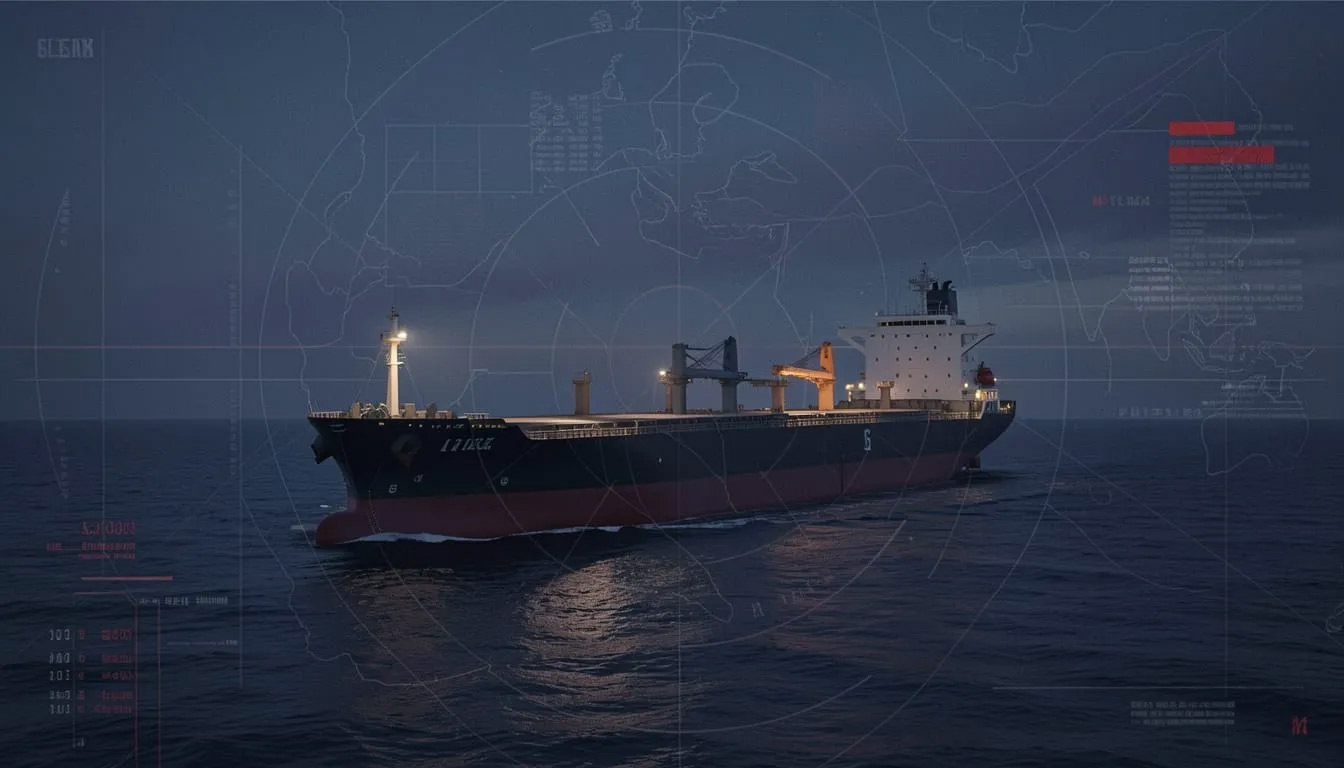
On February 24, 2026, the UK Foreign, Commonwealth and Development Office added 297 entries to its Russia sanctions list: 240 entities, 7 individuals, and 50 ships. The UK Russia vessel sanctions round on February 24, 2026 is unusually large for this regime; 50 ship specifications in a single action. FleetLeaks has processed all 50 into our database. This post examines what was designated, how it shifts cross-jurisdictional coverage, and where the gaps remain.
Key Findings
- 48 of 50 vessels were already designated by the EU. Today’s action closes a UK coverage gap, not new identifications.
- Two LNG carriers (KUNPENG and LNG SOARS) were individually specified. FleetLeaks has not previously recorded LNG carriers designated under the UK’s Russia regime.
- 31 of 50 vessels have AIS position history in FleetLeaks. Terminal call data covers 20 of 50, with 42 recorded visits across 10 Russian facilities.
- 797 behavioral events were detected across 9 of the 50 vessels, including 16 AIS gaps clustered in the Danish Straits chokepoint.
- Harmonization tightened: UK and EU vessel lists now overlap on 539 vessels. The UK+EU gap with OFAC (the US Office of Foreign Assets Control) remains the largest deficit at 352 vessels.
- The EU’s 20th package is blocked. Hungary vetoed adoption on February 23 over a Druzhba pipeline dispute. The package includes 43 additional vessel designations and a full maritime services ban.
Download: Full list of UK-designated vessels in this round (CSV).
What the UK Designated: 50 Vessels, 175 Entities, and the 2Rivers Network
The FCDO sanctions notice names 50 ships under The Russia (Sanctions) (EU Exit) Regulations 2019. The bulk of these vessels are oil tankers linked to a single network.
Foreign Secretary Yvette Cooper described the package as targeting “critical financing, military equipment and revenue streams that sustain Russia’s aggression.” The FCDO stated that international sanctions have deprived Russia of an estimated $450 billion in revenue since the invasion began. The UK’s total Russia sanctions list now exceeds 3,000 entries across individuals, entities, and vessels.
The 2Rivers Network
The core target is the 2Rivers trading network, formerly known as Coral Energy. The UK designated 175 companies within this network alongside the 50 vessels. 2Rivers was founded by Azerbaijani businessman Tahir Garayev in 2010 and has operated through layers of shell companies registered in Dubai, Singapore, India, and Mauritius.
A joint Red Alert issued by the National Crime Agency and OFSI last year mapped the network’s structure. The NCA described a “blue” side of Western-facing entities providing access to trade finance, insurance, and commodity exchanges, and a “red” side with deliberately obscure ownership structures trading Russian oil directly. The NCA warned at the time that sanctioned entities would likely be replaced by freshly incorporated companies. Today’s action appears aimed at the network’s breadth.
Also designated: PJSC Transneft, which the FCDO says is responsible for transporting over 80% of Russia’s oil exports, and nine Russian banks including Tochka Bank, Post Bank, and Ak Bars Bank.
Two LNG Tankers
Among the 50 vessels, FleetLeaks identified two LNG carriers: KUNPENG (IMO 9247194, flagged Panama) and LNG SOARS (IMO 9307205, flag not yet confirmed). FleetLeaks has not previously recorded LNG carriers individually specified under the UK’s Russia sanctions regime.
The LNG designations are worth noting in context. The EU’s proposed 20th sanctions package includes bans on maintenance and technical services for LNG tankers and icebreakers. The UK may be aligning its vessel-level designations with the direction Brussels has signaled.
AIS Tracking Coverage
FleetLeaks holds AIS position history for 31 of the 50 vessels designated by the UK today. Of those, 18 have recorded positions in 2026, and three were broadcasting as recently as February 24:
- Ethera (imo-9387279/”>IMO imo-9387279/”>9387279), last seen under way off the Moroccan Atlantic coast at 34.89°N, 8.46°W.
- PROMETEI (imo-9296597/”>IMO imo-9296597/”>9296597), at anchor near Casablanca at 33.80°N, 7.38°W.
- Stanislav Govorukhin (imo-9621596/”>IMO imo-9621596/”>9621596), at anchor in the Strait of Gibraltar at 35.87°N, 5.60°W.
Several geographic clusters are visible in the data. At least five vessels were last observed in the Singapore Strait area, a known hub for ship-to-ship (STS) oil transfers. Six vessels were last recorded at anchor near Port Said or the Suez Canal approaches.
Two positions stand out for proximity to Russian oil infrastructure. Guanyin (imo-9299707/”>IMO imo-9299707/”>9299707) was last tracked on January 22 at 70.24°N, 34.93°E. Briont (imo-9252955/”>IMO imo-9252955/”>9252955) was last recorded moored at 44.51°N, 37.60°E. General Skobelev (imo-9503304/”>IMO imo-9503304/”>9503304) was last seen under way near Tallinn at 59.56°N, 22.91°E on February 11.
The remaining 19 vessels have no AIS position history in FleetLeaks’ database. This includes both LNG tankers. As MMSI identifiers are confirmed, these vessels will be added to the monitoring pipeline.
Terminal Visit Records
FleetLeaks terminal call data contains 42 recorded visits by 20 of the 50 newly designated vessels across 10 Russian oil and gas terminals. The data spans August 2025 through February 2026. A “terminal call” in FleetLeaks is defined as a vessel entering a monitored terminal geofence polygon and dwelling for a minimum threshold period, detected via AIS position data.
The most active loading terminals for these vessels were Kozmino (14 visits), Primorsk (9), and the CPC marine terminal off Novorossiysk (8). Ust-Luga recorded 3 visits, with the remainder spread across St. Petersburg, Vysotsk, Nakhodka, Vanino, and Murmansk.
The most recent terminal calls in the dataset:
- Guanyin (imo-9299707/”>IMO imo-9299707/”>9299707) called at Murmansk/Kola Bay on February 12, 2026, with a dwell time of approximately 31 hours. This is consistent with the vessel’s AIS position at 70.24°N noted above.
- Kayseri (imo-9292199/”>IMO imo-9292199/”>9292199) called at CPC Novorossiysk on February 5, with a dwell of roughly 2 hours, suggesting a loading operation.
- Indri (imo-9247429/”>IMO imo-9247429/”>9247429) called at Primorsk on January 29, dwell approximately 14.5 hours.
- PROMETEI (imo-9296597/”>IMO imo-9296597/”>9296597) called at Primorsk on January 28, dwell approximately 3 hours.
- Innovator (imo-9306809/”>IMO imo-9306809/”>9306809) made two calls at Kozmino in January (January 8 and January 20), each with dwell times over 37 hours.
Three vessels account for 18 of the 42 recorded calls. Kayseri visited CPC Novorossiysk seven times between August 2025 and February 2026. Guanyin made six calls at Kozmino, Nakhodka, and Murmansk between November 2025 and February 2026. Denver (imo-9382712/”>IMO imo-9382712/”>9382712) made six calls at Kozmino and Vanino between August and September 2025.
FleetLeaks tracks 41 Russian oil and gas terminals. The 30 vessels with no terminal call records may load at facilities outside our current monitoring coverage, or may operate in segments of the supply chain (such as STS transfer zones) that do not involve direct terminal calls.
AIS Behavioral Events
FleetLeaks’ automated event detection system has recorded 797 behavioral events involving 9 of the 50 designated vessels: 544 zone dwell detections, 237 loiter events, and 16 AIS gap events. No STS proximity candidates were detected for this group.
AIS Gaps: Danish Straits Clustering
The 16 AIS gap events range from 4 to 6.5 hours in duration. The geographic pattern is notable. Five vessels recorded gaps in the Fehmarn Belt area of the western Baltic (~54.4°N, 11.7°E): PROMETEI, Indri, Manaslu, Jin Hui, and Prisma. Four vessels recorded gaps in the Kattegat or Great Belt (~55–56°N, 11°E): PROMETEI, Indri, Manaslu, and General Skobelev.
The Danish Straits are the primary chokepoint for Russian Baltic crude exports transiting to open ocean. AIS coverage in this area is dense. FleetLeaks flags these gaps for investigation but cannot determine from AIS data alone whether they reflect equipment issues, satellite coverage anomalies, or deliberate transmission interruptions.
Two gaps carry additional context. Indri (imo-9247429/”>IMO imo-9247429/”>9247429) went dark for approximately 4.5 hours on January 30 at 60.20°N, 27.83°E, a position consistent with the Primorsk terminal approach. The vessel’s terminal call data confirms a Primorsk loading visit the day before. Prisma (imo-9299678/”>IMO imo-9299678/”>9299678) recorded four gaps during a single northbound transit between February 17 and February 23: off Portugal (4 hours), twice in the English Channel (5 hours each), and in the southern Baltic near Bornholm (5 hours). That pattern, four gaps in six days along a single voyage, warrants monitoring.
Loitering: Baltic Terminal Approaches
The loiter data is dominated by PROMETEI (imo-9296597/”>IMO imo-9296597/”>9296597), which generated over 170 consecutive loiter events in the Russia Baltic Transit zone between January 20 and January 27. The vessel held position near 59.86°N, 25.98°E for approximately six days. That location is in the Gulf of Finland, consistent with a vessel waiting for a loading berth at Primorsk or Ust-Luga. PROMETEI‘s terminal call data shows a Primorsk visit on January 28, the day after the loitering ended.
Indri and Myra (imo-9336490/”>IMO imo-9336490/”>9336490) both recorded loiter events at the Ust-Luga terminal zone on January 19. Manaslu (imo-9388027/”>IMO imo-9388027/”>9388027) loitered in the Primorsk zone on January 20. Stanislav Govorukhin (imo-9621596/”>IMO imo-9621596/”>9621596) was loitering off Ceuta as of February 24, the day of the UK designation. Ceuta is a known STS and bunkering hub in the Strait of Gibraltar.
How We Detect These Events
FleetLeaks uses automated detection against live AIS position streams. The definitions below apply to all behavioral events referenced in this post.
AIS gap: A vessel stops transmitting AIS for 120 minutes or longer while previously moving at over 2 knots. Gaps may reflect equipment failure, satellite coverage holes, or deliberate shutoff. The system flags gaps; analysts evaluate context.
Loiter event: A vessel maintains speed at or below 1.0 knot for 90 minutes or longer in open water. Legitimate causes include anchoring, weather delays, and waiting for port orders. Events in known STS zones or terminal approaches carry higher investigative weight.
STS candidate: Two vessels within 800 meters, both at 1.0 knot or below, for 120 minutes or longer with stable mutual proximity. No STS candidates were detected for this vessel group.
Harmonization: FleetLeaks counts unique vessels by IMO number. Flag changes and name changes do not create duplicate records. A vessel is counted as “sanctioned by N jurisdictions” if it appears on the active designation list of N of the six monitored authorities (US OFAC, EU, UK OFSI, Canada, Australia, New Zealand).
FleetLeaks Database: UK Russia Vessel Sanctions Coverage
UK Russia Vessel Sanctions: Cross-Jurisdiction Coverage Snapshot
Following today’s pipeline run, FleetLeaks tracks 884 unique vessels sanctioned by at least one of six jurisdictions. The per-jurisdiction counts:
| Jurisdiction | Vessels |
|---|---|
| EU | 597 |
| UK | 595 |
| US (OFAC) | 464 |
| Canada | 410 |
| New Zealand | 210 |
| Australia | 155 |
Today’s pipeline created 2 new vessel records (KUNPENG and LNG SOARS, both UK-only at this time) and added UK designation dates to 48 existing records. Of those 48, all carried prior EU designations: 30 from the EU’s October 2025 package, 8 from December 2025, and the remainder from earlier rounds dating to May 2025. One vessel, Skadi (imo-9230971/”>IMO imo-9230971/”>9230971), already carried both US and EU designations and is now sanctioned by all three Western authorities.
Harmonization: Where Jurisdictions Align and Where They Do Not
FleetLeaks monitors sanctions harmonization across all six jurisdictions. The February 2026 UK Russia vessel sanctions update materially shifted overlap metrics between London and Brussels. The distribution as of today:
| Jurisdictions covering the vessel | Vessel count |
|---|---|
| 1 jurisdiction only | 281 |
| 2 jurisdictions | 155 |
| 3 jurisdictions | 113 |
| 4 jurisdictions | 188 |
| 5 jurisdictions | 133 |
| All 6 jurisdictions | 14 |
603 vessels (68% of the database) are sanctioned by two or more jurisdictions. 14 vessels face designations from all six. The remaining 281 are sanctioned by a single authority only.
UK and EU Overlap
The UK and EU lists are now closely aligned in size (595 and 597 respectively). 539 vessels carry designations from both. Today’s update was the primary driver of that convergence: 48 vessels that the EU had previously designated now also carry UK sanctions.
24 vessels remain UK-only, meaning they are sanctioned by the UK and neither the EU nor the US. These are largely from today’s new designations.
The US Gap
352 vessels are sanctioned by both the UK and the EU and are not designated by OFAC. This is the largest jurisdictional gap in the dataset. OFAC designations carry distinct enforcement weight because of the dollar’s role in global trade and the extraterritorial reach of US secondary sanctions. A vessel sanctioned in London and Brussels faces real commercial consequences. A vessel also on the OFAC SDN list faces a qualitatively different level of risk for any counterparty touching the US financial system.
OFAC’s 464 designated vessels reflect a different targeting approach. Washington has focused heavily on entity-level designations (owners, operators, managers) alongside vessel specifications. The vessel-level gap does not necessarily indicate a policy disagreement; it may reflect different enforcement strategies. We note this gap as an observable fact, not an assessment of effectiveness.
The EU’s 20th Package: Proposed, Blocked, Pending
On February 6, European Commission President Ursula von der Leyen announced the 20th sanctions package. The proposal includes:
- A full maritime services ban for Russian crude oil, coordinated with G7 partners. This would prohibit EU-based companies from providing shipping, insurance, financing, or other services for Russian oil transport regardless of price.
- 43 additional shadow fleet vessel designations, which would bring the EU total to 640.
- Bans on maintenance and services for LNG tankers and icebreakers.
- Restrictions on 20 more Russian regional banks and measures targeting cryptocurrency platforms.
- First activation of the EU anti-circumvention tool, blocking exports of CNC machines and radios to high-risk re-export jurisdictions.
The Commission cited a 24% decline in Russian oil and gas fiscal revenues in 2025, the lowest level since 2020, with January 2026 revenues at a wartime low. Russian interest rates stand at 16%.
The Veto
The package was expected to be adopted by February 24. On February 23, at the Foreign Affairs Council in Brussels, Hungary vetoed the package. Slovakia supported the veto.
The dispute is about oil transit through the Druzhba pipeline. Deliveries to Hungary and Slovakia through the Ukrainian section of Druzhba stopped in late January. Ukraine attributes the stoppage to Russian drone strikes on pipeline infrastructure. Hungary and Slovakia say Ukraine is delaying repairs. Hungarian Foreign Minister Péter Szijjártó stated explicitly that Hungary would block both the 20th sanctions package and a €90 billion EU loan to Ukraine until oil supplies resumed.
EU foreign policy chief Kaja Kallas called the outcome “a setback and a message we didn’t want to send today.” She noted that work on the package would continue. EU Council President Antonio Costa and Commission President von der Leyen are expected to raise the issue directly with Hungarian Prime Minister Viktor Orbán.
Slovakia escalated separately. Prime Minister Robert Fico suspended emergency electricity exports to Ukraine, calling the pipeline halt a “hostile act.”
The sanctions package remains pending. FleetLeaks will update our database when it is adopted.
What This Means for the Shadow Fleet
The February 2026 UK Russia vessel sanctions round lands at a moment when the EU’s 20th package remains blocked. According to analysis from the Institute for Black Sea Strategic Studies, Russia set a record for Baltic Sea crude exports in January 2026 at 12.7 million tonnes. Approximately 47.7% of those volumes moved on tankers already sanctioned by at least one Western jurisdiction.
The EU’s proposed maritime services ban would remove the remaining EU-owned and EU-insured tankers from Russian crude transport. Lloyd’s List analysis found that EU-controlled tankers still accounted for 19% of Russian liftings last month, with the majority controlled by Greek entities. The ban would push those volumes onto the shadow fleet.
This raises a question the sanctions community has not resolved. The result would push all Russian crude onto aging, poorly insured, opaquely owned vessels and eliminate the last points of Western visibility into those trades. It also removes the compliance fiction that the price cap regime has maintained. Whether this outcome strengthens or weakens enforcement depends on assumptions about monitoring capacity and port state willingness that we cannot verify from available data.
What We Know, What We Do Not, and What Would Change This
Known. The UK designated 50 vessels and 175 entities in the 2Rivers network on February 24, 2026. FleetLeaks has processed all 50 into the database. 48 already carried EU designations. Two LNG carriers are new to the dataset. AIS coverage exists for 31 of 50. Terminal call data covers 20 of 50. Behavioral event detection covers 9 of 50. The UK and EU vessel lists now overlap on 539 vessels. The EU 20th package is blocked by Hungary.
Unknown. MMSI identifiers for 19 vessels remain unconfirmed, preventing AIS monitoring enrollment. We have no AIS or terminal data for either LNG carrier. The EU 20th package adoption timeline has no resolution date. Whether OFAC will mirror any of the 50 UK designations is unclear. The speed at which 2Rivers can reconstitute through new shell companies is an open question; the NCA warned this is the network’s standard operating pattern.
What would change our assessment. Publication of the EU 20th package in the Official Journal would add 43 vessels and trigger a full pipeline run. OFAC mirroring of any UK designations would narrow the 352-vessel harmonization gap. Confirmed STS proximity events involving these vessels would elevate behavioral risk signals. MMSI confirmation for the 19 untracked vessels would expand AIS monitoring coverage. Any new entity registrations appearing in ownership chains for these vessels would indicate 2Rivers network reconstitution.
All vessel data referenced in this post is drawn from the FleetLeaks database, updated daily from official government sanctions lists across six jurisdictions. Individual vessel pages are available by searching IMO number. Cross-jurisdictional harmonization data is available on our harmonization page.
Sources
- FCDO Sanctions Notice, 24 February 2026 (PDF)
- UK Sanctions List, GOV.UK
- NCA/OFSI Red Alert: Shadow Fleet Sanctions Evasion Network (PDF)
- European Commission 20th Sanctions Package Statement, 6 February 2026
- Kyiv Independent: EU 20th Package Stalls, 23 February 2026
- Daily News Hungary: Hungary and Slovakia Block 20th Package, 23 February 2026
- Visegrad Insight: Shadow Fleet in the Baltic Sea
- Insurance Journal / Bloomberg: UK Targets 2Rivers Network, 24 February 2026